Minister: Rough is "not something that the Government is choosing to invest in"
A government minister has said the Government is not choosing to invest in Britain's largest gas storage facility, despite its owner seeking a regulated support mechanism and the energy department acknowledging that long-term financial support for gas storage operators may be required.
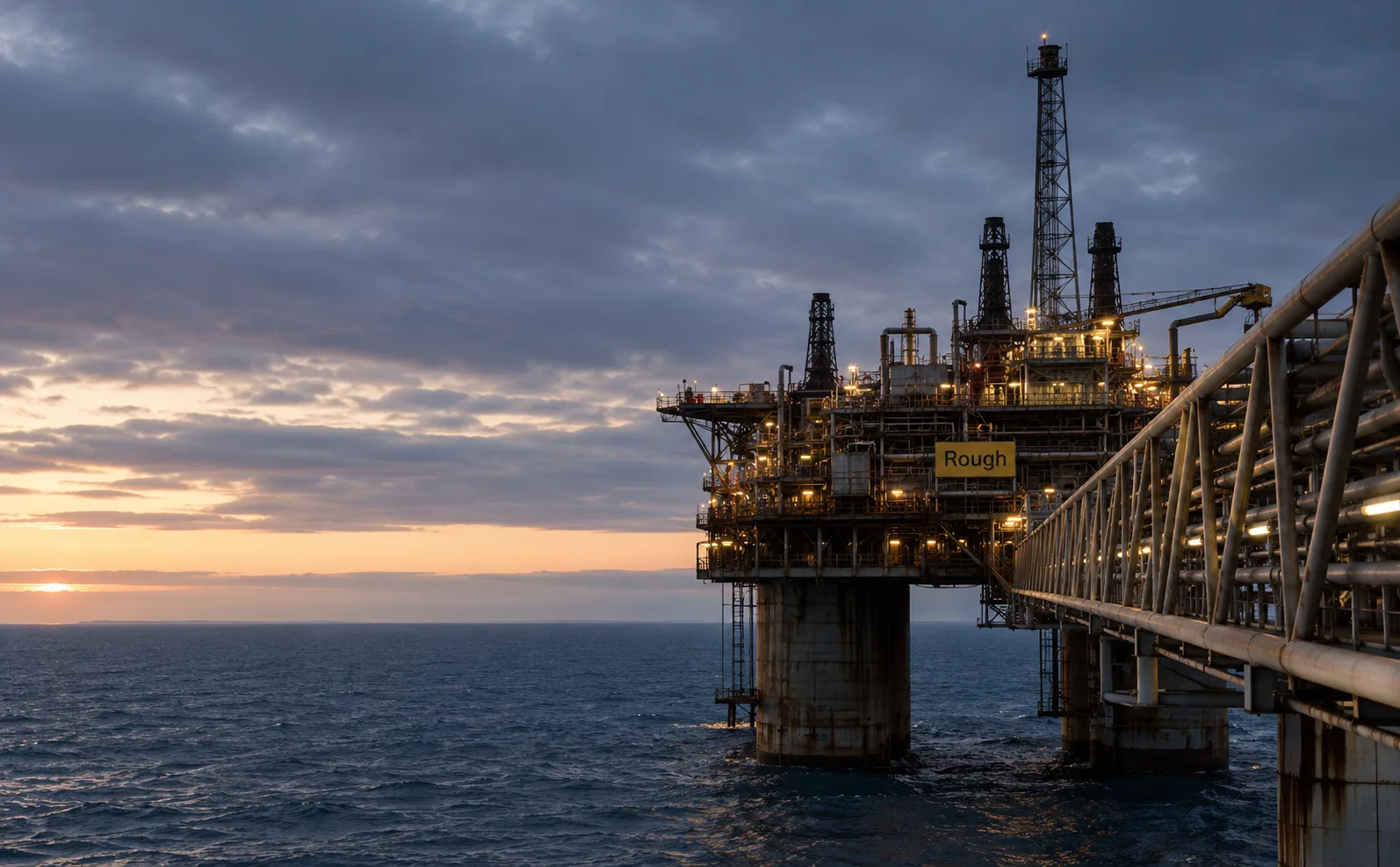
Luke Pollard, a defence minister, told BBC Radio 4's Today programme on Tuesday that Rough, the North Sea facility operated by Centrica, "is not something that the Government is choosing to invest in".
"Centrica are a big company with deep pockets. They can choose their investments that they want to make," Mr Pollard said. "This is a very clear commercial decision for the company. The steps that we're taking as a Government are to come off the fossil fuel roller-coaster with more investment in renewables."
Rough accounts for about half of the UK's gas storage capacity and sits 18 miles off the East Yorkshire coast, connected to the Easington terminal. Mr Pollard's remarks were first reported by The Telegraph. He speaks for neither the Department for Energy Security and Net Zero, which holds the gas storage policy brief, nor the Energy Secretary, and his comments do not constitute a departmental decision on Centrica's proposal.
Centrica seeks a cap-and-floor mechanism for £2bn of investment
Centrica has been in talks with ministers about applying a cap-and-floor mechanism to the site, under which the company would fund the work itself and receive a top-up if revenues fell below an agreed level, with returns capped if they rose above it. The arrangement would be underwritten through household energy bills.
Chris O'Shea, Centrica's chief executive, said: "The future of Rough is too important to the UK to be dismissed as simply a 'commercial decision'. The UK's energy security cannot be taken for granted, and Rough is an opportunity to strengthen our national security and resilience, safeguard existing jobs, create new ones and drive investment and growth in the UK."
He said the company was not asking taxpayers to fund the investment but was "asking for the Government to apply its existing cap-and-floor regulatory framework to unlock it", adding: "We are ready to invest £2bn of our own money in critical national infrastructure. Government should not allow this opportunity to be lost."
Rough's operating consent runs to April 2027, and Centrica has confirmed that it does not currently intend to extend it. The company has told the BBC the site was set to lose about £100m in 2025 and would be decommissioned without investment. Mr O'Shea has said the UK holds about 12 days of gas storage, of which Rough provides six, and that full use of the site would raise that to between 25 and 30 days.
How Britain's storage capacity was run down
Rough came into service as a storage facility in 1985. In June 2017 Centrica announced it would close the site, saying it was uneconomical and had reached the end of its design life, and the Department for Business, Energy and Industrial Strategy, then led by Greg Clark, declined to subsidise repairs. The closure drew warnings at the time that Britain would become more exposed to volatile prices.
UK storage capacity now equates to roughly 5% of annual gas demand, against an EU average of about 29% in 2024, according to a Lords written answer.
The position reversed in 2022. Kwasi Kwarteng, then Business and Energy Secretary, opened talks with Centrica about reopening the site as prices rose after Russia's invasion of Ukraine. The North Sea Transition Authority approved the application, and Centrica brought 20% of capacity back into service on 28 October 2022. It doubled Rough's capacity the following year.
The support framework already exists elsewhere in the energy system
The support model Centrica wants has a precedent in UK energy regulation. In October 2024 the government confirmed it would introduce a cap and floor scheme for long-duration electricity storage, following a consultation published in January 2024 under the previous administration, with Ofgem developing the scheme.
For gas, the Department for Energy Security and Net Zero launched its Gas System in Transition: Security of Supply consultation on 26 November 2025 and closed it on 18 February 2026, receiving 115 responses. The interim response, signed by Michael Shanks, the Minister for Energy, records that "a long-term commercial model in the form of financial or revenue support may be required", and that such a scheme "is most likely to be of benefit to GB's gas storage operators and two bi-directional gas interconnectors, where profit margins and forward bookings are in long-term decline". It states that "any form of government intervention or investment in the gas market would be unprecedented" and that a full response setting out the government's "minded to" position will follow.
No such response has been published. The government has yet to take a formal decision on Rough, and a spokesman declined to comment. In May 2025 the department said the site's future was "a commercial decision for Centrica" while adding that it remained "open to discussing proposals on gas storage sites, as long as it provides value for money for taxpayers".
Winter supply position and the North Sea decisions
EU storage entered the winter at 72% of capacity on 1 October 2026, down from 83% a year earlier, according to the ENTSOG Winter Supply Outlook 2026/27 published on 8 October. The report's Reference Winter scenario, which assumes Russian pipeline supply is minimised, has EU storage falling to 29% by 31 March 2027 under optimal LNG supply and to 13% under tight LNG supply. ENTSOG states that if LNG availability remains limited, storage levels "could fall well below 30% by the end of the winter", and that the North-Western Region, which includes the UK, remains comparatively low. The European Commission said the same day that the EU system is sufficiently flexible to meet demand while warning that a severe cold snap could require demand reductions of up to 15%.
ENTSOG attributes the tightness to the conflict in the Middle East, which it says has reduced LNG supply from the region and constrained shipping through the Strait of Hormuz, a route accounting for around 20% of global LNG trade. Reuters reported on 12 October that Iranian missile attacks had knocked out about 17% of Qatar's export capacity.
The Telegraph reported that the assessment warned UK gas storage could be completely depleted by spring if a cold snap sweeps across the country. ENTSOG's published findings are aggregated at EU level, and the report does not set out a separate UK depletion scenario.
European benchmark prices reached about €86 per megawatt hour on Tuesday, their highest for four years, after six consecutive days of gains. Prices stood at about €32 per megawatt hour on the eve of the Iran war, which began in late February.
The warnings come as the Prime Minister, Andy Burnham, faces decisions on the Jackdaw and Rosebank oil and gas fields. Consents for both were granted under the Conservative government and were quashed by the Court of Session in January 2025 after a challenge by Greenpeace and Uplift, on the basis that the decisions had not accounted for emissions from burning the extracted fuel. The government did not contest the challenges. Under the process set out by the Institute for Government, fresh consents must be granted by the Energy Secretary, Ed Miliband, and the North Sea Transition Authority. A consultation on Jackdaw has closed.
Research reported on 13 October estimated that rejecting the fields would forgo £11bn of economic value over a decade, put at £10.8bn in ITV's account of the same study. The Telegraph reported that Mr Burnham was expected to approve Jackdaw during a visit to Scotland.
Great British PAC reaction
Claire Bullivant, Chief Executive of the Great British PAC, said:
“This is an extraordinary display of complacency from a Labour Government that seems determined to sacrifice Britain's energy security on the altar of its own net zero obsession.
“Here we have a British company prepared to invest £2 billion of its own money in critical national infrastructure, protecting jobs, strengthening our resilience and helping to safeguard families against future energy shocks. And what is Labour's response? A minister shrugs his shoulders and tells the company it has 'deep pockets'. What an utterly breathtaking failure to grasp the seriousness of the situation.
“Rough provides around half of Britain's gas storage capacity. We have precious little storage compared with our European neighbours, energy markets are increasingly volatile, and the world is becoming more dangerous by the day. Yet Labour appears perfectly content to gamble with one of the country's most important strategic assets.
“You cannot power a modern industrial nation on wishful thinking, and you cannot keep the lights on with ideological slogans. Wind turbines and solar panels have their place, but they do not eliminate our need for gas, particularly when the wind isn't blowing and the sun isn't shining.
“And let us be absolutely clear: nobody is asking Labour to write Centrica a blank cheque. The company is asking ministers to consider an established regulatory mechanism that could unlock private investment. Surely a serious Government would examine that proposal properly rather than dismissing the issue with glib remarks.
“Energy security is national security. It is about keeping our homes warm, our factories running, our businesses competitive and our country independent of hostile regimes and unstable international markets.
“Labour seems to have confused an energy policy with a climate crusade, and it is British families who will end up paying the price.
“Britain should be producing more of its own energy, protecting its strategic reserves and backing British industry. Instead, we have a Labour Government that appears more interested in appeasing the net zero lobby than securing the nation's future.
“A Government that cannot guarantee its country's energy security has fundamentally misunderstood its first duty: to protect the British people.”