
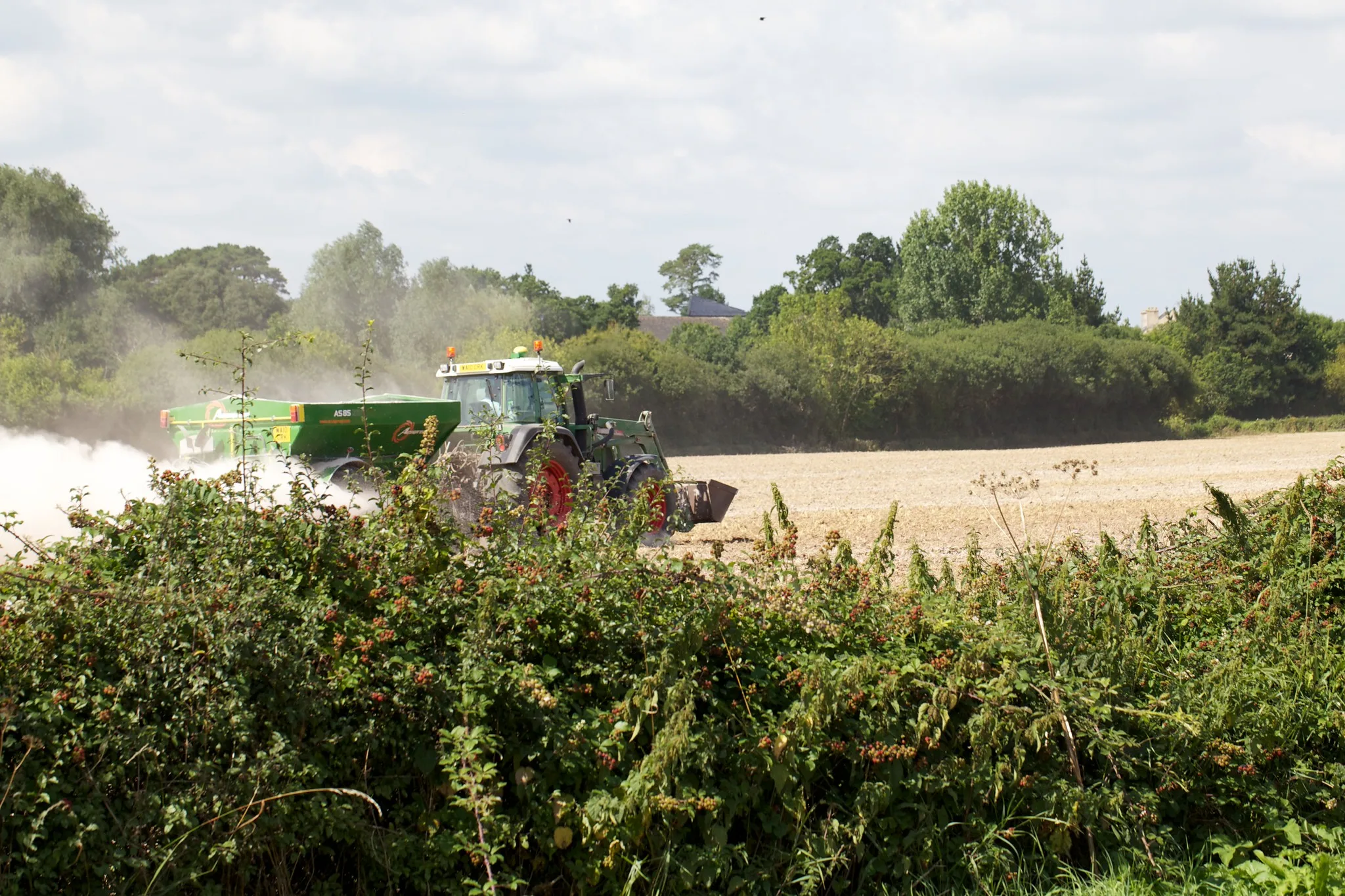
Farmers are being advised to have 75% of their fertiliser requirements ordered for delivery before the end of the year, as buying picks up ahead of the introduction of the UK Carbon Border Adjustment Mechanism (CBAM).
Frontier Agriculture said although fertiliser purchases have increased over the past three to four weeks, the market remains behind where it would normally be at this stage of the season. The recent increase has been driven primarily by crops going into the ground and beginning to establish, but CBAM is also influencing purchasing decisions alongside concerns over availability, logistics and wider upward price pressure.
The advice was set out in a report published by Farmers Guide on 7 October 2026.
Frontier has advised growers who have yet to secure their 2027 fertiliser requirements to continue with a "little-and-often" purchasing strategy.
It said: "At this stage we would advise growers to now have 75% of their requirements ordered for delivery before the end of the year – if it isn't already on farm.
"This gives room for further purchases to take account of changes to cropping areas, future market movements and when we eventually understand the true cost impact of CBAM in year one."
CBAM takes effect from 1 January 2027 and places a carbon cost on the emissions embodied in certain imported goods, including fertiliser. In HMRC's official policy paper, the mechanism is described as a new tax ensuring that highly traded, carbon intensive imports face a carbon price comparable to that paid by manufacturers producing the same goods in the UK under the UK Emissions Trading Scheme.
The market remains behind
While demand on farm is now broadly in line with what would normally be expected at this point in the season, Frontier said a significant shortfall earlier in the year means cumulative demand remains below typical levels. The industry is still carrying what Frontier called a "sizeable seasonal deficit" and remains under pressure to organise stocks ahead of spring demand.
Nitrogen-based solid products, particularly ammonium nitrate (AN) and urea, alongside liquid UAN, are currently seeing the greatest demand. Demand for products containing sulphur is also increasing, with Frontier expecting further buying due to the larger oilseed rape area.
Frontier said the immediate concern is less about overall product supply and more about the industry's ability to move fertiliser onto farms when it is needed. With around 55 delivery days remaining this year, there is a limited window to catch up before the traditionally busy spring delivery period.
A tax made in Westminster
CBAM is a British tax, charged to the importer when the product enters the UK rather than when it is delivered to farm. Its path into law is a matter of record.
The policy was set out by the Conservative government in a consultation launched in March 2023, when Jeremy Hunt was chancellor, and the Treasury confirmed in its December 2023 consultation response that the UK would introduce a CBAM. A further consultation on the design ran from March to June 2024, and the October 2024 response fixed key decisions on scope.
The Labour government then confirmed the start date at the Autumn Budget on 30 October 2024, when Rachel Reeves was chancellor, with the measure scored in the budget documents. Provision for HMRC to prepare the tax was included in the Finance Act 2025, and the substantive legislation was enacted in Part 5 of the Finance Act 2026, sections 142 to 158 of which establish the CBAM, with section 158 providing that the tax has effect in relation to goods imported into the United Kingdom on or after 1 January 2027. Both Acts were passed under the current Labour administration. Further design decisions were confirmed at Budget 2025, including the exclusion of indirect emissions at implementation.
The tax applies to imported goods from the aluminium, cement, fertiliser, hydrogen, and iron and steel sectors. Businesses importing £50,000 or more of these goods over a 12-month period must register with HMRC. The tax applies to relevant imports from 1 January 2027, and government guidance states that registration for CBAM will open by 1 January 2028. Importers who become liable before registration opens must keep records of the CBAM goods they have imported so they can register when the service is available. The Exchequer impact is scored at £140 million for 2027 to 2028, rising to £180 million the following year, figures certified by the Office for Budget Responsibility.
Britain's fertiliser industry relies on imported ammonia
The tax lands on a fertiliser market that no longer has a domestic nitrogen base. CF Fertilisers UK announced in July 2023 that it would permanently close its ammonia plant at Billingham, the largest in the country, after the closure of the Ince plant in 2022. The company said it would continue producing ammonium nitrate at Billingham using imported ammonia.
Frontier has therefore warned that costs associated with CBAM will ultimately be felt across imported nitrogen fertiliser. The eventual CBAM charge will be determined by three factors: the carbon cost, based on the UK Emissions Trading Scheme; the embedded emissions associated with the product; and a free allowance adjustment.
Frontier said some of the figures needed to make that calculation remain unknown, making it impossible to currently calculate the precise cost of CBAM on a product.
It said: "CBAM will increase the cost of every fertiliser which contains nitrogen that is used in the UK arriving after 1st January 2027.
"The challenge currently is that the industry is awaiting further clarity from the government in order to understand how much that cost will be, so as it stands, the full implications remain unknown."
The industry has already pushed back
The pressure on the Treasury is not new. In April 2026 the NFU formally called for a delay to CBAM, having previously warned it would push up the cost of fertiliser for farmers, particularly in the arable sector. NFU Scotland raised the same concerns in August 2026, warning the mechanism could increase fertiliser costs and squeeze farm margins further.
In May 2026, The Guardian reported that ministers had held talks over suspending the carbon tax on fertiliser to curb food inflation, with fertiliser prices at the time running around £618 a tonne according to the Agriculture and Horticulture Development Board.
CBAM is charged at the border, so fertiliser delivered after 1 January will not necessarily be subject to the charge if it has already entered the country. Frontier has previously advised that purchasing decisions should not be based solely on CBAM, but has said the mechanism needs to be considered as part of growers' wider plans. The company has also called for joined-up government action on fertiliser policy.
Frontier's head of crop nutrition, Ed Downing, said: "Fundamentally, if buying fertiliser now is the right decision based on the market, then it will also avoid any CBAM cost, helping to further reduce some risk in the short term. But it really comes down to the individual farm."
Great British PAC reaction
Claire Bullivant, Chief Executive of the Great British PAC, said:
“What on earth is this Labour Government playing at? British farmers are already being hammered by rising costs, squeezed margins and relentless uncertainty, and now Labour is pressing ahead with another tax that threatens to make producing British food even more expensive.
“Think about the sheer madness of this. We have lost our domestic ammonia production, we depend on imports, and now the Government wants to slap a carbon charge on the fertiliser our farmers need to grow the food that feeds our nation. Worse still, with just weeks to go, the industry cannot even tell farmers how much it is going to cost them. What sort of way is that to run a country?
“Farmers cannot plant uncertainty, harvest government promises or pay their bills with Net Zero slogans. They need affordable fertiliser, fair conditions and a government that understands the difference between protecting the environment and punishing the people who produce our food.
“And who does Labour think will ultimately pay when the cost of growing food rises? British families, of course. The very people already struggling with the cost of living.
“You cannot tax British farming into prosperity, and you cannot build food security by making it more expensive to grow food in Britain.
“Food security is national security. Our farmers are not the enemy. They are the backbone of this country, and it is about time Westminster started treating them that way.”
And Richard Thomson, former Royal Marine and National Director of Great British PAC added:
„Britain’s farmers have already been hammered by soaring costs, punishing taxes and endless regulation. Now they are being told to stockpile fertiliser before Rachel Reeves’s carbon border tax takes effect.
This is Net Zero ideology colliding with economic reality.
Fertiliser is not a luxury. It is essential to growing food. Make it more expensive and farmers pay more, British agriculture becomes less competitive, and families face higher prices at the checkout.
A government that destroys its own agriculture in pursuit of arbitrary carbon targets is not protecting the environment. It is undermining our industry, our food security and our national independence.“