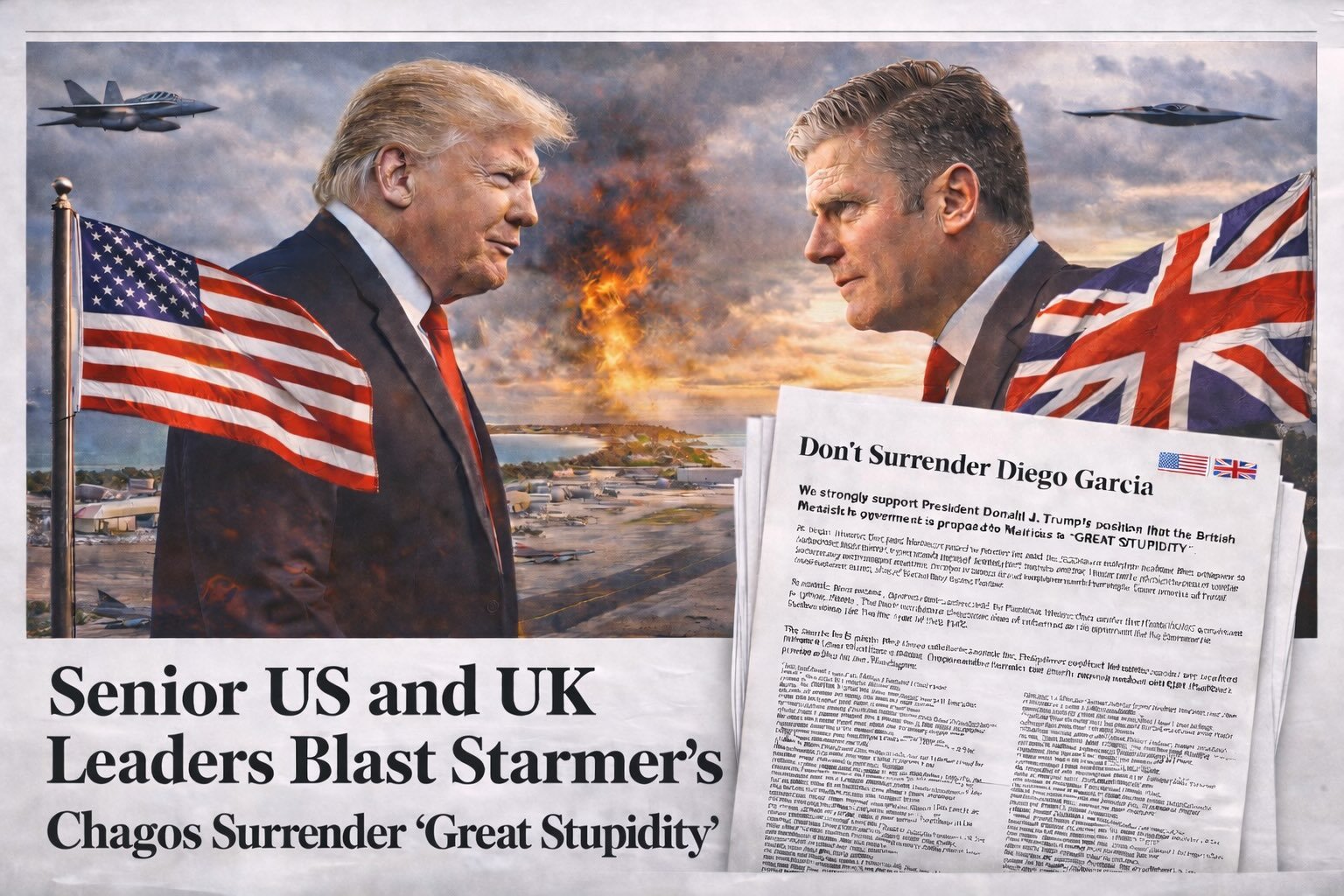
It is not every day that retired admirals, sitting peers, Pentagon old hands and university professors find common cause across the Atlantic. Yet Labour's plan to surrender the Chagos Islands to Mauritius has done precisely that. A weighty bloc of senior defence veterans, politicians, academics and one-time national security officials from Britain and the United States has gone public to savage the proposal, calling it reckless, destabilising and a gift to Britain's rivals.
Their joint statement does not mince words. Backing Donald Trump's blunt assessment that the scheme amounts to “GREAT STUPIDITY,” its more than 80 signatories registered their “strong support” for the President and cautioned that Sir Keir Starmer is wagering one of the West's most important military relationships on a deal they consider indefensible.
Why does a single remote atoll draw such firepower? The answer is Diego Garcia, a speck in the Chagos archipelago that carries a major U.S. base — the linchpin for American activity stretching from the Middle East to the Indo-Pacific. For now the territory belongs to Britain, which both owns and runs it. London, however, has been negotiating to pass sovereignty to Mauritius and then rent Diego Garcia back across a 99-year lease.
That structure, the coalition warns, would drill a fresh and dangerous fault line into the transatlantic partnership. Britain would be committing billions of dollars merely to retain its own foothold, and — critically — should a single payment be missed, the entire lease could collapse, leaving the American base with no firm legal ground beneath it.
The treaty trap and the nuclear question
There is a further snag the signatories highlight: Mauritius is bound by the Pelindaba Treaty, which declares Africa a zone free of nuclear weapons. Because the United States never confirms nor denies whether nuclear arms sit at its overseas installations, the group reasons that the moment sovereignty changes hands, U.S. forces would be wide open to lawsuits and orchestrated diplomatic offensives.
“The strategic consequences would be profound,” the statement cautions. The remedy it presses on Washington is twofold: lean on London to recommit to the 1966 UK–U.S. defence accord that governs Diego Garcia, and throw out any side-deal with a third country that could chip away at it.
Names that carry weight on both shores
What gives the letter its punch is its range — retired admirals and generals, former Pentagon officials, legal academics and politicians both serving and former. The British roll-call features Nigel Farage, Sir Iain Duncan Smith, ex-defence secretary Grant Shapps, the historian David Starkey and a clutch of peers from the Lords. On the American flank stand former National Security Council figures, top Navy and Marine Corps commanders, and strategists steeped in Indo-Pacific planning.
Those behind the campaign say the volume of names is a deliberate statement in itself.
“This is not a fringe protest or a fleeting political squall,” remarked one of the figures circulating the letter. “It is a gathering storm of experienced figures who believe the proposed deal would be a historic error, and one that could seriously damage U.S. UK relations.”
A shot across Downing Street's bow
The salvo lands at an uncomfortable moment for the Prime Minister, with the Mauritius talks still dragging on and the eyes of the world fixed ever tighter on them. The coalition's critics flatly reject the idea that this is some tidy bit of territorial housekeeping; to them it is a litmus test of whether Britain can still be relied upon as America's closest defence partner.
Hand away sovereignty, they argue, only to lease back a base the alliance cannot function without, and you blunt Britain's own bargaining power, hand ammunition to anyone seeking to challenge American deployments in court or through diplomacy, and seed doubt across a region already tense with sharpening competition between the great powers.
Boiled down to its slogan — “Don't Surrender Diego Garcia” — the message is due to be placed in Trump's hands within days, all but guaranteeing the Chagos row becomes a live and combustible thread in relations between the two capitals.
Whether the government holds firm or quietly shifts ground, the statement settles one thing beyond dispute: hostility to the Chagos deal has outgrown the usual party-political battle lines. It has consolidated into a serious transatlantic alliance, one squaring up to confront Westminster directly over a gamble it deems far too risky to make.
What the statement says
Headed “Don't Surrender Diego Garcia!”, the letter opens by endorsing the President — the signatories “strongly support” Donald J. Trump's view that handing the Chagos islands to Mauritius is “GREAT STUPIDITY”.
It then walks through the history. Back in 1966, Britain and the United States concluded an “Exchange of notes constituting an agreement concerning the availability for defense purposes of the British Indian Ocean Territory”, clearing the way for America to build the substantial military facilities that now sit on Diego Garcia. The letter notes that the base ranks among the most significant the United States operates anywhere beyond its own borders, that the 1966 agreement runs until 2036, and that it expressly provides: “The Territory shall remain under United Kingdom sovereignty.”
Despite that wording, the signatories observe, ministers are pressing ahead with a deal that would transfer Diego Garcia and the wider Chagos group to Mauritius. Under those terms Britain would gift Mauritius the islands and then pay billions of dollars across 99 years to rent Diego Garcia back — and, as the letter stresses, a single missed payment could end the lease and leave the American base sitting illegally on Mauritian soil.
Worse still, the statement argues, Mauritius has signed the Pelindaba Treaty barring nuclear weapons from its territory. Given the long-standing U.S. practice of refusing to “neither confirm nor deny” such weapons, the signatories warn that the instant Diego Garcia passes to Mauritius, America would be exposed to legal challenge. Pressing the case home, they again “strongly support” Trump's warning that ploughing on with the Mauritius deal is an act of “GREAT STUPIDITY” that risks doing irreparable harm to the special relationship.
The letter closes with a demand: Washington should insist that Britain recommit to the existing bilateral agreement governing “the availability for defense purposes” of Diego Garcia, and disown any arrangement with another party that would breach or otherwise jeopardise that accord.
Among the signatories
United States:
- Lt. Gen. Thomas L. Conant, U.S. Marine Corps (Ret.), former Deputy Commander, U.S. Indo-Pacific Command (2012–2014)
- Brig. Gen. Jerry McAbee, U.S. Marine Corps (Ret.)
- Rear Adm. Mark Montgomery, U.S. Navy (Ret.), Senior Director, Foundation for Defense of Democracies
- Capt. James Fanell, U.S. Navy (Ret.), Geneva Centre for Security Policy
- Col. Grant Newsham, U.S. Marine Corps (Ret.)
- Raul (Pete) Pedrozo, Howard S. Levie Chair on the Law of Armed Conflict, U.S. Naval War College
- Frank Gaffney, former Assistant Secretary of Defense (Acting), Institute for the American Future
- Professor Arthur Waldron, University of Pennsylvania
- Professor June Teufel Dreyer, University of Miami
- Kerry K. Gershaneck, Professor and Author, U.S. Marine (Ret.), Global Risk Mitigation Foundation (GRMF), Honolulu, Hawaii
- Professor Victor H. Mair, University of Pennsylvania
- Dede Laugesen, President, Save the Persecuted Christians
- Col. Rob Maness, U.S. Air Force (Ret.), Veterans Leadership Fund
- George Parker, Executive Director, Revealing Light Ministries
- James Grundvig, journalist
- James Sturdevant II, retired Defense Intelligence Agency (DIA) intelligence officer (GG-14) and analyst across INDOPACOM, SOUTHCOM, EUCOM, AFRICOM and CENTCOM
- Capt. Stuart Cvrk, U.S. Navy (Ret.)
- Lt. Cmdr. Geoffrey Wilson, U.S. Navy (Ret.), Fanell’s Red Star Risen
- Capt. Jim Newman, U.S. Navy (Ret.), Strategic Capabilities Office (SCO SETA)
- Col. Philip Lark, U.S. Marine Corps (Ret.), Marshall Center
- Capt. Donald Henry, U.S. Navy (Ret.)
- Capt. David Rosenberg, U.S. Navy (Ret.)
- Capt. Timothy Lyon, U.S. Navy Reserve (Ret.)
- Capt. James R. Everett III, U.S. Navy (Ret.)
- Cmdr. Markham B. Dossett, U.S. Navy Reserve (Ret.), President, TALON ASSET Management LLC
- Robert Eldridge, President, The Eldridge Think Tank
- Karen Siegemund, President, American Freedom Alliance
- James Sturdevant II, retired DIA counterintelligence officer and China–Taiwan–South Asia subject-matter expert, U.S. Government (Ret.)
- Brian Kennedy, Chairman, Committee on the Present Danger: China
- Bradley Thayer, Fellow, American Freedom Alliance
- Lt. Col. Chuck DeVore, U.S. Army (Ret.)
- Alexander Gray, former Deputy Assistant to the President and Chief of Staff, White House National Security Council (2019–21)
- Craig Ozaki, retired U.S. Navy officer
- Jorge Parrott, President, Christ’s Mandate For Missions
- The Honorable George Rasley, Editor, ConservativeHQ.com
- Constance Elliott, Member, Committee on the Present Danger: China
- Col. John B. Atkinson, U.S. Marine Corps (Ret.)
- Col. Wayne Morris, U.S. Marine Corps (Ret.)
- Col. Peter Miller, U.S. Marine Corps
- Col. Stephen Baird, U.S. Marine Corps (Ret.)
- Lt. Col. Robert Barrow, U.S. Marine Corps (Ret.)
- Master Chief Petty Officer Bill Treadwell, U.S. Navy (Ret.)
- Cmdr. Glenn Looney, U.S. Navy (Ret.)
- Cpl. Daniel Billman, U.S. Marine Corps
- Jeffrey Nash, President, JNLD, Inc
- Jane Stein, Owner, Janestein-Stage-Elements.com
- Cpl. Robert Rohrer, U.S. Marine Corps
- Lew Kennedy, Navy nuclear specialist, veteran
- Master Gunnery Sgt. Lawrence McCarteny, U.S. Marine Corps (Ret.)
- Capt. Steven Clayton, U.S. Marine Corps (Ret.)
- Cmdr. Mark Johnson, U.S. Navy Reserve (Ret.)
- Lawrence Peter, U.S. Navy (Ret.)
- Col. Richard Dunn, U.S. Marine Corps (Ret.)
- Rod Martin, Esq., Chairman of the Board, Institute for the American Future
- Lt. Col. Tim Wilson (Retd.), British Army
- Howard Hills, U.S. Navy Judge Advocate General’s Corps (JAG) (Ret.), Lead U.S. Counsel, Compact of Free Association (COFA) negotiations
- Capt. Mark M. Drake, U.S. Navy (Ret.)
- Brian Colfack, Bruce Byron, Paul Berkowitz, William Schroeder, Peter Brown, Peter Watson and Michael Champley
United Kingdom:
- Rear Adm. Christopher John Parry, CBE (Retd), Royal Navy; defence analyst and military commentator
- Sir Iain Duncan Smith, former Leader of the Conservative Party and Conservative MP for Chingford & Woodford Green; Co-Chair, Inter-Parliamentary Alliance on China (IPAC)
- Lord Hannan of Kingsclere (Daniel Hannan), Conservative peer; writer, columnist and founding President of the Institute for Free Trade
- Nigel Farage, Leader of Reform UK
- Lord Ashcroft, KCMG PC (Michael Ashcroft), businessman, philanthropist and author; former Deputy Chairman and Treasurer of the Conservative Party; Founder and Chairman of Crimestoppers
- Sir Bill Cash CH, long-serving Conservative MP and Chair of the European Scrutiny Committee
- Baroness Hoey of Lylehill and Rathlin, crossbench peer and former Labour MP
- The Earl of Leicester, hereditary peer in the House of Lords
- Baroness Foster of Aghadrumsee, member of the House of Lords (crossbench, formerly Conservative)
- Lord Strathcarron, member of the House of Lords
- Andrew Wigmore, political consultant and campaigner; former political adviser
- The Rt Hon Sir Grant Shapps, former Defence Secretary and Conservative MP
- Lord Cruddas of Shoreditch (Peter Cruddas), Conservative peer; Founder and CEO of CMC Markets plc
- Dr David Starkey CBE, historian and broadcaster specialising in British history
- Ben Habib, Leader of Advance UK
- Dr Nile Gardiner, foreign policy expert and former aide to Margaret Thatcher; director of a Washington-based think tank