
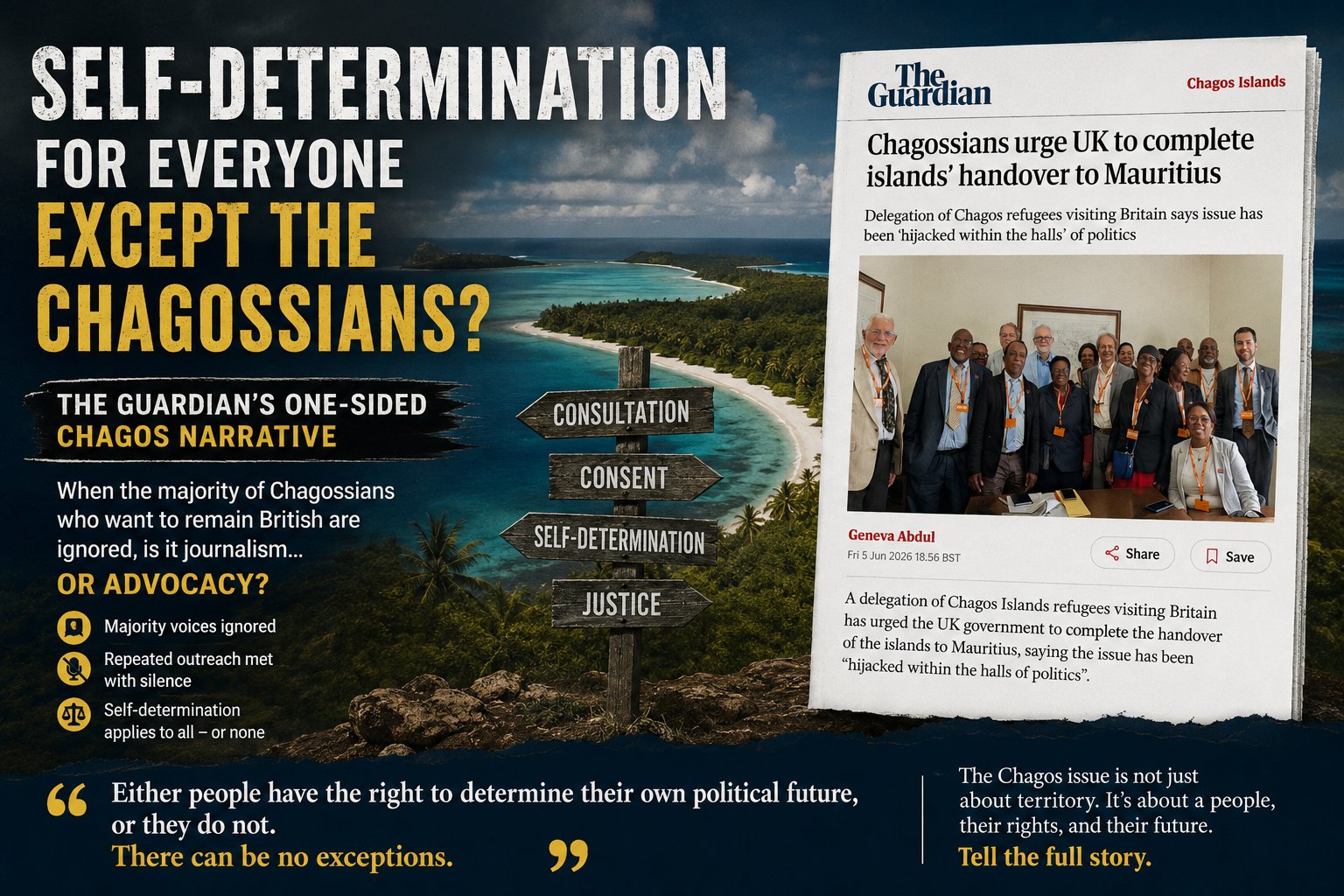
A single newspaper article can reveal as much about the publication that ran it as about the subject it covers. The Guardian's latest piece on the Chagos Islands is a case in point: read closely, it says a great deal about where the paper's editorial sympathies lie.
Last week the Guardian's readers were handed a warm and detailed account of Louis Olivier Bancoult and the Chagos Refugees Group as they pressed Parliament to finish handing sovereignty to Mauritius. Their case was laid out at length, their arguments taken seriously and their concerns placed front and centre. What is telling, however, is not the contents of the article but the gaps in it.
Nowhere did the piece acknowledge the polling that shows most Chagossians want to stay British, nor the expanding movement inside the Chagossian community that opposes the handover.
Over the past eighteen months, one of the defining shifts in the Chagos debate has been the mounting resistance from Chagossians who feel shut out of decisions about their own future. Campaigners, community representatives, diaspora groups and community leaders have raised concern after concern about consultation, consent and self-determination.
Repeatedly, those voices have found it almost impossible to break through in the major outlets. We can speak to this directly. Across the past year, the Great British PAC has tried again and again to engage particular journalists, the Guardian's among them, offering evidence, offering interviews and flagging developments that cut against the dominant story. What came back, for the most part, was silence.
And yet the moment a small delegation lands in Britain in support of the handover, the Guardian is ready with a long and sympathetic write-up. That imbalance prompts perfectly fair questions. Why are certain Chagossian voices boosted while the majority who wish to remain British go unheard? Why are readers shown only one face of a fiercely contested issue, with other viewpoints treated as if they scarcely exist?
None of this is to say Louis Olivier Bancoult or anyone in his delegation should be silenced. They are fully entitled to put their views and argue their corner. The trouble is that the job of journalism is to give readers the whole picture, not to prop up a favoured narrative. A paper that genuinely valued fairness would admit that the Chagossian community is itself deeply split over sovereignty, representation and the islands' future.
Strikingly, the Guardian's article also says nothing of the Chagossian Government in Exile, created after a verified ballot of Chagossians in December 2025. More than 90 per cent of those who took part backed its formation, and Interim First Minister Misley Mandarin was elected with overwhelming support. Whatever one makes of that step, it marks a significant political development within the Chagossian community and puts beyond doubt that no consensus stands behind the current arrangements.
Above everything, the Guardian declines to grapple honestly with the principle at the very core of this dispute: self-determination.
For years, politicians, activists and papers like the Guardian have held up self-determination as a basic democratic right. They have insisted that communities ought to be free to shape their own future without having decisions imposed on them by far-off governments. Yet on Chagos, many of those same voices seem ready to drop the principle entirely.
How is it progressive for the United Kingdom and Mauritius to bargain over the islands' future while most Chagossians feel locked out of the process? How can politicians talk endlessly of decolonisation while making decisions over the heads of the very people whose lives stand to be most affected? How can commentators applaud international law while seeming unbothered by whether the people concerned have actually agreed to the result?
The awkward truth is that a good many of those who claim to defend Chagossian rights appear content to tune out Chagossian voices the moment those voices fail to deliver the desired conclusion. That contradiction is becoming harder and harder to overlook.
The forced expulsion of the Chagossians from their homeland by a former Labour government remains one of the gravest injustices in modern British history. No one should make light of that suffering. But righting one injustice is no licence to create another. Putting a historical wrong right cannot mean stripping people of a real say over their own future. If governments truly care about justice, then the wishes of the Chagossian people cannot be brushed aside as an inconvenience.
What makes the Guardian's stance so dispiriting is how selective it appears to be about democratic rights. Were any other indigenous or displaced community to protest that powerful governments were settling their future without proper consultation, the paper would rightly demand scrutiny, accountability and transparency. On Chagos, though, there seems to be little appetite to ask whether the process itself is democratic, legitimate or fair.
Once competing evidence is set aside, inconvenient voices are shut out and only one side of a disputed question is amplified over and over, journalism stops resembling reporting and starts resembling advocacy.
Readers are entitled to know that polling has repeatedly found strong Chagossian support for remaining British. They are entitled to know that serious questions have been raised about consultation and consent. They are entitled to know that a live, ongoing argument is taking place over whether sovereignty should be transferred at all before anyone has established what the Chagossian people actually want.
Most of all, readers are entitled to know that Chagos is not merely a quarrel between Britain and Mauritius. It is about a people. It is about whether a community already scarred by displacement and marginalisation will once more have its future decided for it.
That is precisely why self-determination matters so deeply. It is not a slogan. It is not a political convenience. It is not a principle to be wheeled out only when it yields fashionable results. It is the bedrock of democratic legitimacy. Either people hold the right to determine their own political future, or they do not.
The Chagos debate is not, in the end, about Britain. Nor is it, in the end, about Mauritius. It is about whether the Chagossian people themselves have the right to decide their future. Anyone who claims to champion human rights should find that an easy question to answer.
The Guardian is fond of lecturing others on democracy, justice and human rights. On Chagos, it would do well to hold itself to those very standards. Until it begins telling the whole story, instead of only the parts that suit a preferred worldview, it risks becoming not a chronicler of this debate but a player in it.
The genuine scandal is not that one group of Chagossians has been handed a platform. It is that so many others have spent years trying to tell their story, only to be met with indifference.
For a paper that prides itself on speaking truth to power, that silence speaks volumes.
Claire Bullivant, CEO of the Great British PAC