
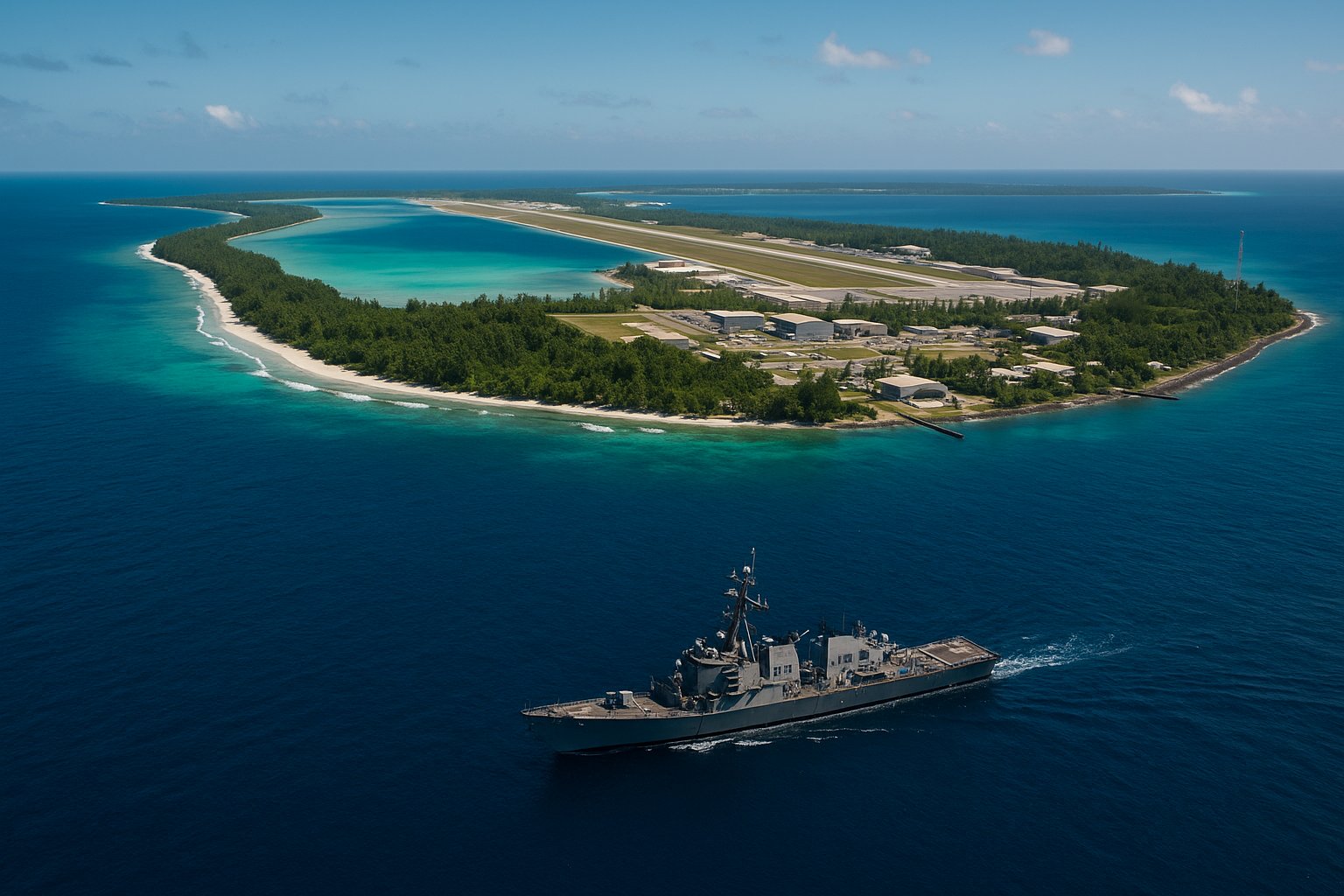
When a government starts paying to rent back land it already owns, something has gone badly wrong. Yet that is precisely the position Keir Starmer has put Britain in by signing away sovereignty over the British-owned Chagos Archipelago, home to the strategically vital United States and United Kingdom military base at Diego Garcia. The decision has triggered alarm among defence analysts, diplomats and senior parliamentarians on both sides of the Atlantic.
The fear running through those circles is straightforward: handing over the islands risks weakening Western security right across the Indian Ocean and could let Chinese and Indian strategic influence creep into one of the most sensitive maritime regions anywhere on the planet.
Those worries are not abstract. Mauritius, which maintains close financial and political relationships with both India and China, struck a broad defence cooperation agreement with New Delhi while Prime Minister Navinchandra Ramgoolam spent eight days in India this September. As reported by The Economic Times and The Times of India, that deal grants Indian naval access to the Chagos Islands, clears the way for hydrographic surveys, and sets out plans for a satellite tracking facility “near the Diego Garcia United States and United Kingdom base”. Indian outlets have billed the proposed installation as a “strategic asset for monitoring the region” — language that is typically code for intelligence-gathering.
No exact location for the Indian facility has been confirmed. But analysts note that comparable infrastructure is already up and running on Agaléga, another Mauritian island that has effectively become an Indian military outpost.
The deeper Mauritius leans on Indian economic and diplomatic backing — while carrying heavy debts to China — the more the archipelago looks like contested ground. “Mauritius is balancing on a knife edge between India and China,” a senior British defence official said. “Placing Diego Garcia under Mauritian sovereignty introduces enormous uncertainty about the long-term security guarantees that underpin United States and United Kingdom operations there.”
A Fragile Security Balance
The May 2025 sovereignty agreement allows the United States to keep running its Naval Support Facility at Diego Garcia through a lease-back arrangement once Britain formally winds up the British Indian Ocean Territory administration. The treaty is not yet ratified, and members of the House of Lords are expected to contest several of its provisions in a debate set for Tuesday.
For decades Diego Garcia has been a cornerstone of Western military power, underpinning global logistics, reconnaissance and deterrence. Sitting nearly 1,000 miles from the nearest continental landmass, its remoteness has long shielded it from both regional and state-backed threats. That protection is now eroding fast.
Recent intelligence points to Iran testing long-range drones and missiles that may be able to reach Diego Garcia, while China's growing naval presence across the Indian Ocean has sharpened the strategic contest. Defence planners regard the prospect of non-allied states gaining indirect access to the Chagos region by way of Mauritius as a grave and emerging danger.
Political Fallout in London and Washington
In Westminster the handover has already become a lightning rod. Attorney General Lord Hermer and Labour's chief negotiator Jonathan Powell face scrutiny over claims that serious security concerns were brushed aside during talks. Former United States Secretary of State Mike Pompeo branded Powell “strategically an absolute fool”, cautioning that “Mauritius is a close ally of the Chinese Communist Party, and if Diego Garcia is lost, Chinese power projection will reach the heart of the Indian Ocean”.
Opposition parties have promised to review the deal, or even tear it up, should they take office. “This treaty weakens Britain's hand and endangers the Western alliance's most important Indian Ocean base,” one Conservative MP said. “It is unthinkable that the Government is proceeding without full parliamentary scrutiny of the security consequences.”
Reform UK leader Nigel Farage has vowed that, if elected, he would “simply refuse to pay”, branding the handover “a betrayal of British sovereignty and common sense”. Even so, some defence analysts caution that walking away could carry its own dangers.
“One of the few things that could make Beijing happier than this handover would be for Britain to renege on it,” a senior defence expert said. “A British default would hand China a propaganda victory, give Mauritius justification to expel the United States and the United Kingdom from the islands, and could unravel the entire security architecture of the Indian Ocean. It would be the single greatest strategic blunder of the century.”
Unanswered Questions
Crucial questions remain open. Nobody knows whether a new Mauritian government would allow United Kingdom or United States defensive infrastructure to be extended to neighbouring islands such as Peros Banhos, which could host air defence or early warning sites. Nor is there any safeguard to keep the 250,000 square mile Marine Protected Area — patrolled by British forces and serving as both a buffer and an early warning perimeter for Diego Garcia — in place.
With regional tensions climbing and the future of Diego Garcia's defences uncertain, critics contend that Britain is giving up far more than territory; it is giving up strategic foresight. “We are effectively paying to lease back our own base,” a former defence minister said. “It is an extraordinary act of short-term thinking that could reshape the balance of power in the Indian Ocean for decades.”