Let us be blunt about something that ought never to have required saying. The Chagos Islands are British. They are British today, they should remain British tomorrow, and no amount of diplomatic horse-trading between politicians in London, Washington and Port Louis changes that simple fact.
That such a sentence has to be written at all, in 2026, tells you everything you need to know about how badly wrong this extraordinary saga has gone.
For years now the Chagossian people have looked on while politicians, diplomats, lawyers and international organisations have wrangled over the future of their homeland. Deals have been drafted. Officials have flown back and forth. Governments have negotiated and meetings have been held behind closed doors. And through it all, the one group never properly asked what they actually want has been the Chagossians themselves.
It is 2026, for goodness sake.
The notion that the future of an entire people can be settled over their heads, by politicians sitting thousands of miles away, belongs to a different century altogether.
We are forever being lectured about democracy, human rights and self-determination. We are told these principles are universal, sacred, and to be honoured wherever they apply.
Apparently not if you happen to be Chagossian.
The Chagossians are a distinct people, with a history, culture and identity of their own. Most hold British citizenship. Many have spent decades campaigning for the right to return to the homeland from which a former Labour Government removed their families. Generation after generation has carried the pain of exile without ever surrendering the hope of going home. They are not an inconvenience to be managed, nor a footnote to some diplomatic agreement. Theirs is the homeland at stake, and they have every right to decide its future.
The question could hardly be simpler. If handing the islands to Mauritius really is such a brilliant idea, why are its champions so unwilling to put it to the Chagossian people in a vote? Why not trust democracy? Why not ask those who actually belong to the islands? Why is every voice welcome except the one that matters most?
The answer is plain enough. The political class already knows how that vote would go.
The overwhelming majority of Chagossians want to stay British. They want to return home as British citizens. They want their children and grandchildren raised under the British flag, in the homeland their families never stopped loving.
For Keir Starmer and those determined to force this surrender through, that reality is deeply inconvenient.
And the irony is almost too much to bear. Transferring the islands to Mauritius, we are repeatedly assured, is an act of decolonisation. Yet what could possibly be more colonial than powerful governments deciding the future of an indigenous people without their consent? This is not decolonisation at all. It is colonialism in modern dress, the Chagossians once again being told that other people know best.
The irony is almost unbearable. We are repeatedly told that transferring the islands to Mauritius is an act of decolonisation. Yet what could be more colonial than powerful governments deciding the future of an indigenous people without their consent?
A record of stewardship Britain should be proud of
Consider, too, what Britain has done with these islands. For more than sixty years it has protected one of the most pristine marine environments anywhere on Earth. The British Indian Ocean Territory spans an area larger than France. Its coral reefs are the healthiest in the world. Its waters teem with extraordinary biodiversity. It remains one of the last truly untouched places on the planet.
None of that happened by accident. For decades British taxpayers have paid handsomely to protect and preserve these islands, their unique ecosystem and the vast marine environment around them. Successive generations have invested in safeguarding one of the world's greatest natural treasures, rather than exploiting it.
That is not a record to be ashamed of. It is one to be proud of.
While marine environments the world over have been ravaged by overfishing, pollution and commercial exploitation, the Chagos Islands stand as living proof that careful stewardship works. Which is precisely why so many people are uneasy about what might come next.
Mauritian ministers are already talking about fishing licences. Talk of future commercial opportunities is already under way. And attention is increasingly turning to the potentially valuable resources that may lie beneath the seabed, as competition intensifies across the globe for the rare minerals and strategic materials likely to prove enormously valuable in the decades ahead.
Where the Chagossians see home, and British taxpayers see a national asset they have spent decades helping to protect, others increasingly seem to see contracts, licences and the chance of profit. That ought to trouble every environmentalist, every taxpayer and everyone who believes in self-determination.
Chagos is a homeland, not a property deal
And now comes the latest twist. Reports suggest that some within the Trump administration are exploring whether America might simply buy the islands.
Buy them. As though Chagos were a property transaction. As though a question of sovereignty, identity and justice could be answered merely by writing a bigger cheque.
With the greatest respect to our American friends, Chagos is not a business deal. It is not a corporate acquisition. It is not a commodity. It is a homeland.
And if America judges the islands strategically valuable enough to buy, surely that is itself the strongest possible argument for Britain not to give them away.
Pause and consider the sheer absurdity of where we have ended up.
The most powerful nation on Earth grasps the value of the Chagos Islands. Military planners grasp it. Security experts grasp it. The Chagossians grasp it. Yet Keir Starmer and his Labour government want to hand over sovereignty and then pay billions of pounds for the privilege of doing so. Only a political class wholly detached from common sense could call that a good deal.
Diego Garcia and Chagossian return are not in conflict
There is another uncomfortable truth that the deal's supporters rarely confront.
Diego Garcia is no ordinary military base. It is one of the most strategically important military facilities on Earth. For decades it has been crucial to protecting Western interests, projecting stability across the Indian Ocean and supporting operations in the Middle East and beyond. Recent events involving Iran have demonstrated its immense strategic value all over again.
The Chagossian people understand this perfectly well. Contrary to the caricature so often peddled by campaigners and politicians, Chagossians are not demanding that Diego Garcia be closed. They recognise its importance. They support the continued presence of the United States and its British allies on the island.
There is no contradiction between backing the base and backing Chagossian self-determination. None between protecting Western security and protecting British sovereignty. None between keeping Diego Garcia and allowing Chagossians to return home as British citizens. In truth, these aims reinforce one another.
A British Chagos, protected by Britain, supported by the United States and home once more to a thriving Chagossian community, would be a remarkable success story. It would strengthen security, strengthen legitimacy and, at last, deliver justice to a people who have waited generations to return.
Instead, we are invited to believe that surrendering sovereignty, paying billions of pounds and ignoring the wishes of the Chagossian people somehow amounts to progress.
A British Chagos, protected by Britain, supported by the United States and home once again to a thriving Chagossian community would be a remarkable success story. It would strengthen security, strengthen legitimacy and finally deliver justice for the people who have waited generations to return.
This story is not over
And let us be candid about how Britain reached this point. It is contemplating the surrender of sovereign British territory because it is governed by a weak and badly misguided administration that seems incapable of standing up for Britain's interests. Rather than defending British sovereignty, protecting British taxpayers and standing with the Chagossian people, Keir Starmer's government has chased a deal that pleases almost everyone except those who must actually live with its consequences.
But this story is far from finished.
Up and down the country, ordinary patriots have refused to accept that the fate of the Chagos Islands is a settled matter. For more than a year the Great British PAC has fought this surrender in the courts and in the court of public opinion. We have stood shoulder to shoulder with Chagossian leaders, campaigners and legal teams, because this is an issue that rises above party politics.
It is about democracy. It is about sovereignty. It is about whether ordinary people still have the right to decide their own future.
Plenty told us that challenging this deal was impossible. Plenty insisted the decision had already been taken. Plenty said there was no point in fighting.
They were wrong.
The Chagossian cause is stronger now than it has been in years. More people understand what is happening. More people are asking questions. More people are recognising the fundamental injustice at the heart of this proposal. And we are not going away.
We will keep fighting. We will keep challenging. We will keep standing alongside the Chagossian people until they finally receive the one thing denied to them throughout this entire process: a meaningful say over their own future.
The remedy was always obvious. Ask the Chagossians. Let them vote. Let them decide. Because if the political class has even a shred of decency, and any genuine faith in the democratic principles it so loves to preach at the rest of us, it has nothing whatever to fear from the answer.
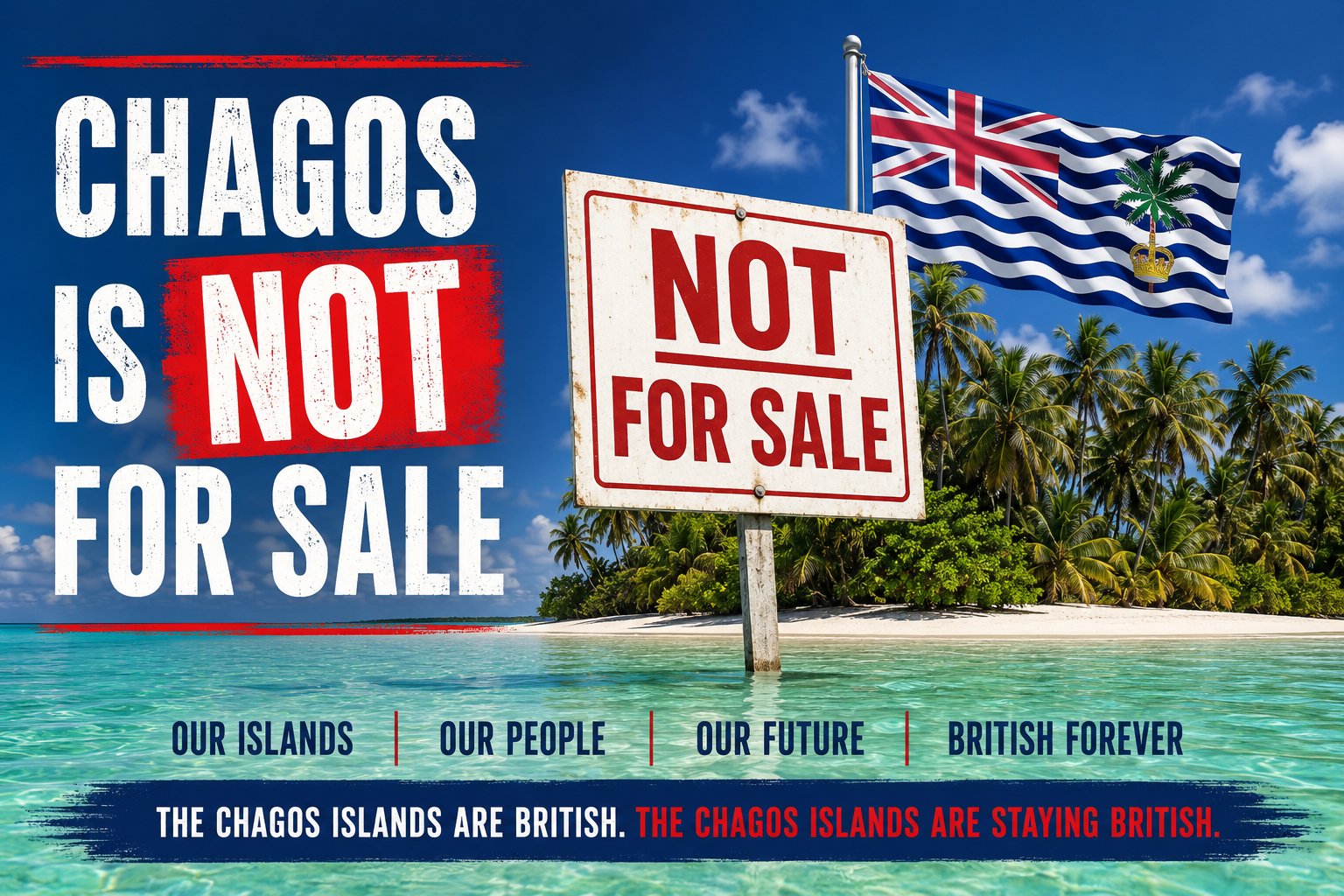
The Chagos Islands are not for sale. They are not a bargaining chip. They are not a diplomatic currency. They are not a line on a Treasury spreadsheet.
There is no cheque large enough, no deal clever enough and no government powerful enough to extinguish a people's right to determine their own future.
The Chagos Islands are the homeland of a people who have waited generations to return. They are British, and they want to stay British.
And that is a truth worth fighting for.
By Claire Bullivant, CEO at Great British PAC