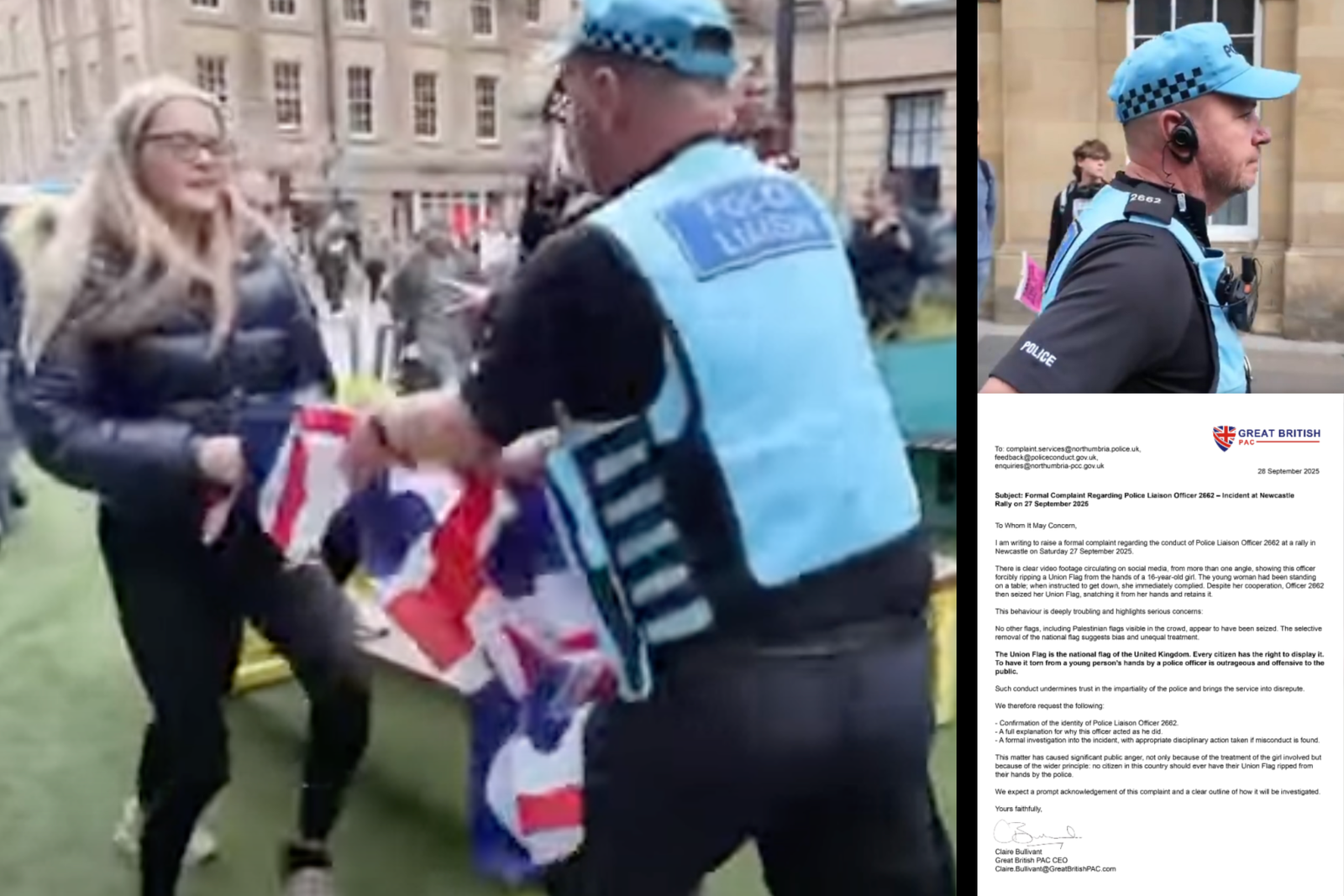
The moment a police liaison officer wrenched the Union Flag from the hands of a 16-year-old girl at a Newcastle rally on Saturday 27 September has put Northumbria Police squarely in the firing line. Footage of the seizure spread quickly online, and the force now faces serious scrutiny over how it polices patriotism.
What happened that day has reopened a fierce national argument about policing, free expression and pride in our flag. It is also now the subject of a formal complaint that we, the Great British PAC, have lodged with the police oversight bodies.
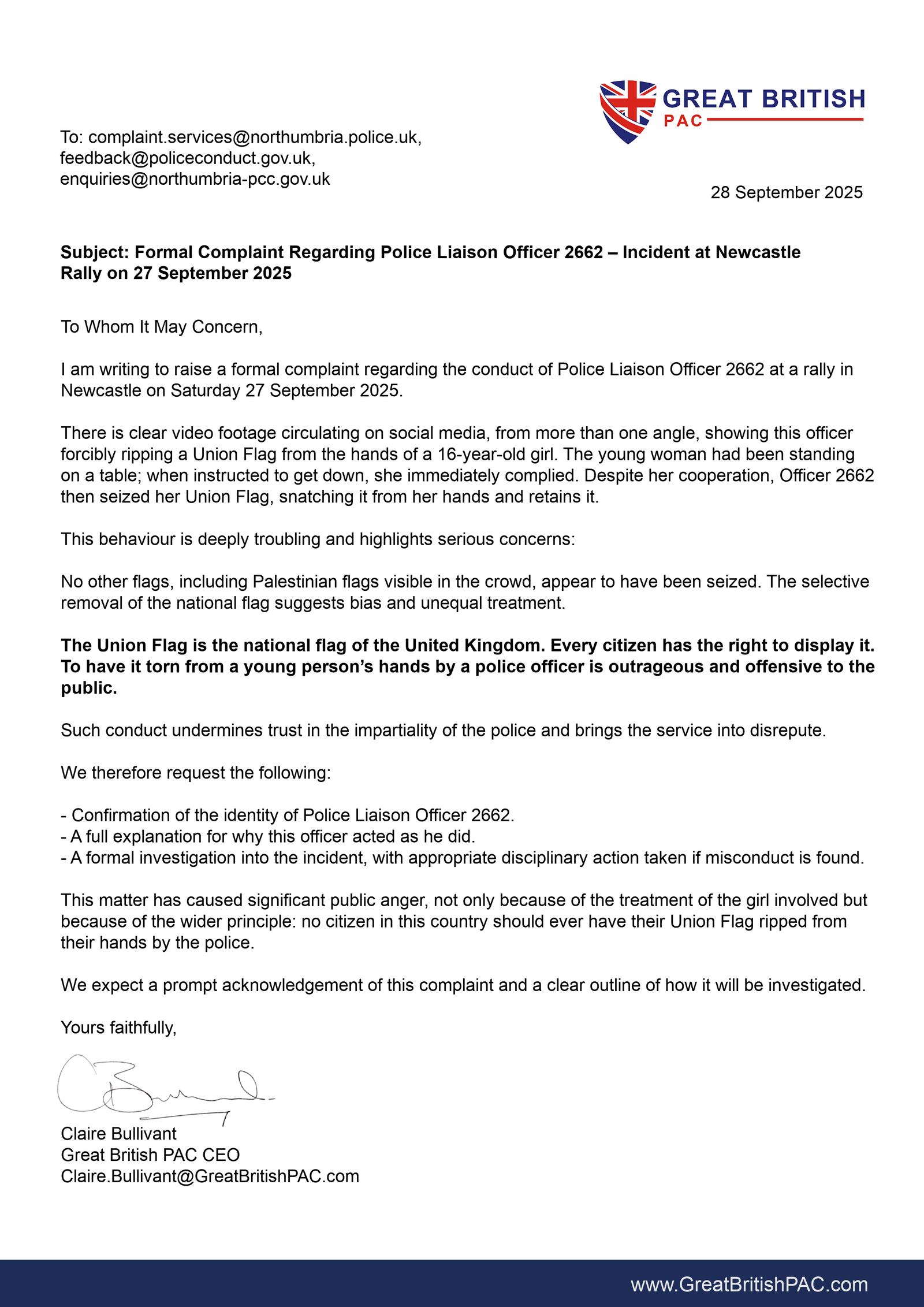
Our letter, signed by CEO Claire Bullivant, has been viewed more than 1.2 million times on X (formerly Twitter). It has drawn offers of legal help from ordinary members of the public, from lawyers, and even from former police officers.
The Incident
In clips shared widely across social media, the teenager can be seen standing on a picnic table waving the national flag. A female officer appears to ask her to step down, and she does so straight away. Seconds later a male officer in a blue “police liaison” tabard — named in our complaint as Officer 2662 — grabs the flag from her hands, crushes it into a ball and walks off with it.
Northumbria Police have since confirmed, according to reports, that the flag was returned. Even so, the sight of the seizure itself has driven public anger.
A 16yr old girl has her flag violently snatched from her by police officers in Newcastle! — Billy Moore (@billymooreAPBD) September 28, 2025
Complaint and Public Reaction
Our complaint accuses Officer 2662 of bias and unequal treatment, noting that no other flags were seized — including the Palestinian flags on show at the very same protest.
“No citizen in this country should ever have their Union Flag ripped from their hands by the police,” we wrote, calling for the officer to be identified, for a full account of his actions, and for a formal investigation.
Nick Tenconi, UKIP leader and Turning Point UK’s chief operations officer, who led the rally, attacked what he called “two-tier policing aimed at demonising patriots.”
The episode has prompted comment from right across the political spectrum. Ian Acheson, a former Home Office director of community safety, judged that the officer’s conduct was “more likely to inflame the protest than reduce tension.”
Wider Context
The girl’s flag was not the only one to cause trouble in Newcastle that day. In a second video, a man carrying an England flag is stopped by police liaison officers and told he could fly it only in “designated areas” under the protest conditions. Onlookers voiced their disbelief that Palestinian flags were being waved freely by counter-protesters.
Northumbria Police stood by their officers, saying they acted to “de-escalate tensions and help ensure the safety of all present.” The force did, however, recognise the controversy, pledging to “review what happened to identify any potential learning.”
A Larger Debate
The row has reignited a wider argument about policing and national identity in Britain. Writing in The Telegraph, journalist David Shipley cautioned that treating the Union and England flags as “provocations” risked casting the police as “an occupying force rather than the guardians of a democracy.”
The political backdrop has sharpened the debate too. On the same day as the Newcastle rally, the Prime Minister branded Reform “an enemy” to the country — prompting questions about whether such rhetoric is bleeding into policing culture.
At the same time, pictures of the 14-metre Brownhills Miner statue in Walsall, draped in a Union Flag, have gone viral. Supporters have hailed the image as a powerful symbol of national pride.
What Happens Next
The Independent Office for Police Conduct (IOPC) is expected to decide whether to launch an investigation into our complaint. Should misconduct be established, Officer 2662 could face disciplinary proceedings.
For now the incident stands as a flashpoint in a broader cultural and political fight. For many, the image of a child’s Union Flag being torn away by a police officer has brought concerns about impartiality, free expression and the future of British policing into sharp focus.