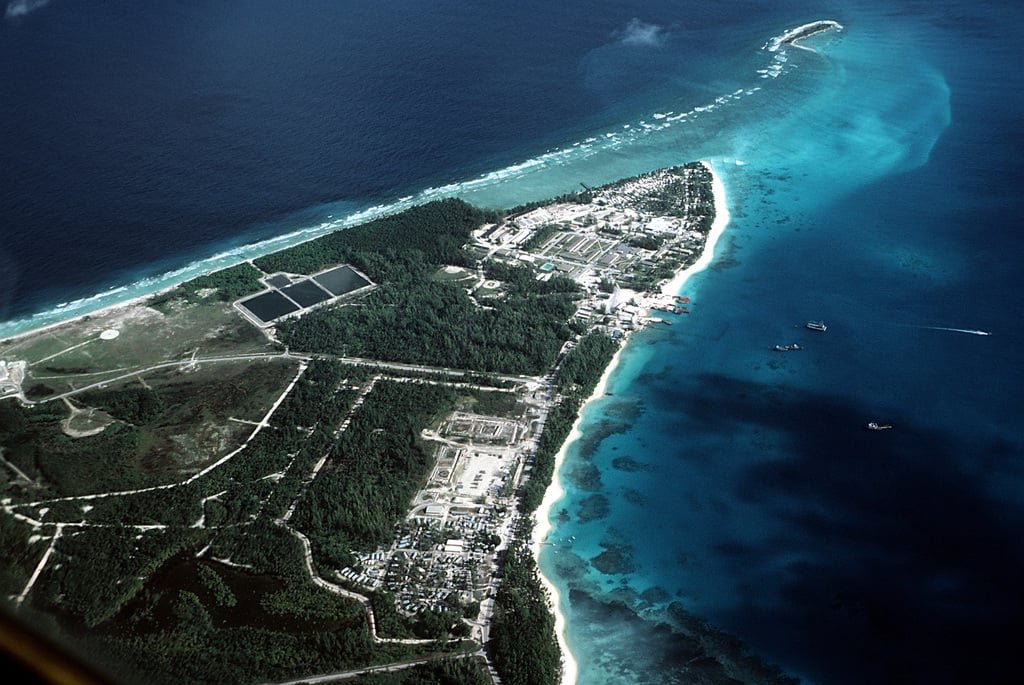
A worsening political crisis in Mauritius over the Chagos Islands settlement has sharpened the unease felt in London and Washington, where officials increasingly suspect that Port Louis is angling for far greater access to, and leverage over, the strategically vital base on Diego Garcia.
As the Mauritian coalition government tears itself apart over what critics brand “excessive concessions” handed to Britain, the rows have exposed something more troubling to Western capitals: even before sovereignty is formally transferred, Mauritian politicians are already arguing in public about who may approach the base, on what terms, and with what limits on surveillance.
For policymakers in Britain and America, the sight is a wake-up call. Run jointly by the UK and US since the 1970s, Diego Garcia ranks among the most important military installations anywhere, underpinning Western power across the Indian Ocean and acting as a springboard for operations stretching from the Middle East to the Pacific.
The internal Mauritian wrangling makes plain, however, that Port Louis does not intend simply to take sovereignty on paper. It means to wield practical control in ways that could bear directly on Western defence operations.
Mauritius’s coalition splits over access to the base
According to The Telegraph, the Mauritian government has been consumed by a dispute over the “excessive concessions” being granted to the UK under Keir Starmer’s Chagos Islands deal. Last week the country’s deputy prime minister, Paul Bérenger, warned that he might withdraw his party from the governing coalition over his misgivings about the treaty.
The reporting says Mr Bérenger took exception to the tight conservation belts ringing Diego Garcia that would curb Mauritian citizens’ access to the base. He is also said to have pressed Prime Minister Navin Ramgoolam over the surveillance of maritime routes around the islands.
Labour’s intention to hand over the territory by the year’s end had already slipped after the prospect of defeat in the House of Lords, where the Government holds no majority. The pressure is growing on other fronts too: the Great British PAC is demanding genuine Chagossian involvement, while a judicial review brought by Chagossian Misley Mandarin is now making its way through the courts.
Under the treaty Keir Starmer signed in May, Britain would give up sovereignty over the British Indian Ocean Territory and pay Mauritius £30bn of British taxpayers’ money across 99 years to lease the base back.
For the Chagossians, driven from their islands between 1968 and 1973 by a previous Labour government, the treaty lands as yet another blow. “Many of them do not want the archipelago to be handed to Mauritius,” The Telegraph notes. Indeed, a survey of more than 3,000 Chagossians found that over 99% want to remain British.
Chagossian Misley Mandarin put it this way: “In 2012 we were promised self determination by the British Government, but instead the Government has not consulted us, but it will give away our homeland, and take away rights like the ability to claim British citizenship – why are we so unworthy of the right to self-determination? Recognised for all other people on crown dependent lands.”
A marine reserve that also fences off Diego Garcia
The situation sharpened on 3 November, when Mauritius unveiled the Chagos Archipelago Marine Protected Area (Campa), among the largest in the world. Covering more than 645,000 sq km, the reserve bans commercial fishing outright and splits the territory into four zones.
One of those zones — a strict conservation belt of 23,712 sq km around Diego Garcia — would “effectively prevent civilian movement near the military base”.
Mr Bérenger is reported to be prepared to resign over the terms, accusing a “gang of five” inside the prime minister’s office of working behind his back. “One of Paul Bérenger’s main points of contention concerns this sensitive issue: concessions deemed excessive are being made to the British in the final stages of the archipelago’s sovereignty,” the Mauritian outlet Defi Media reported.
Tensions eased after a meeting with Mr Ramgoolam last week, though senior officials conceded the truce had been struck out of “necessity”.
Mauritian officials play down the crisis and blame UK politics
Vijay Makhan, special adviser to the deputy prime minister, rejected suggestions that the coalition is in danger and insisted Mr Bérenger had never raised concerns about “excessive concessions”.
He went on to accuse British politicians of trying to wreck the agreement: “The party that initiated the negotiations are now desperately trying to scuttle the agreement based on fabricated narratives,” he said.
Gavin Glover, the Mauritian attorney general, told The Telegraph he would talk through the “security and environmental aspects” of the agreement with UK officials in London on Friday.
“We expect to finalise the ancillary agreements to ensure the implementation of the treaty,” he said.
The discussions are set to span maritime security, the marine protected area, the Chagossian Trust Fund, and even the telephone prefix for Diego Garcia. “The stated objective is to finalise these points by the end of November, before formally drafting them and submitting them for final review,” he added.
A warning signal for the West
For defence officials in Britain and America, the Mauritian row is far more than a domestic spat. The drive to assert access rights, command conservation zones and oversee maritime surveillance — all before sovereignty has even changed hands — reinforces a long-held fear that Mauritius may one day move to curtail or reshape Western military use of Diego Garcia.
There is also concern about handing Chagos to a country bound by the Pelindaba Treaty, which forbids nuclear weapons from transiting its territory. On that basis, Keir Starmer’s plan could effectively restrict the ability of the US and UK to operate freely in a crucial maritime corridor — a move many regard as nothing less than a strategic gift to China.
A former admiral who has served at Diego Garcia warned: “Overnight, Mauritius could block the US and UK from moving nuclear submarines through its waters. It’s a gift to China — it effectively disarms us on that side of the planet.”
For a base so central to US–UK operations worldwide, the implications are serious. The treaty may remain stalled, but the quarrels now breaking out in Port Louis have made one thing unmistakable: Mauritius, an ally of China, expects to take a direct and assertive role around Diego Garcia, and its political class is already fighting over just how far that role should reach. For London and Washington, that realisation alone is enough to send a chill down the spine.