
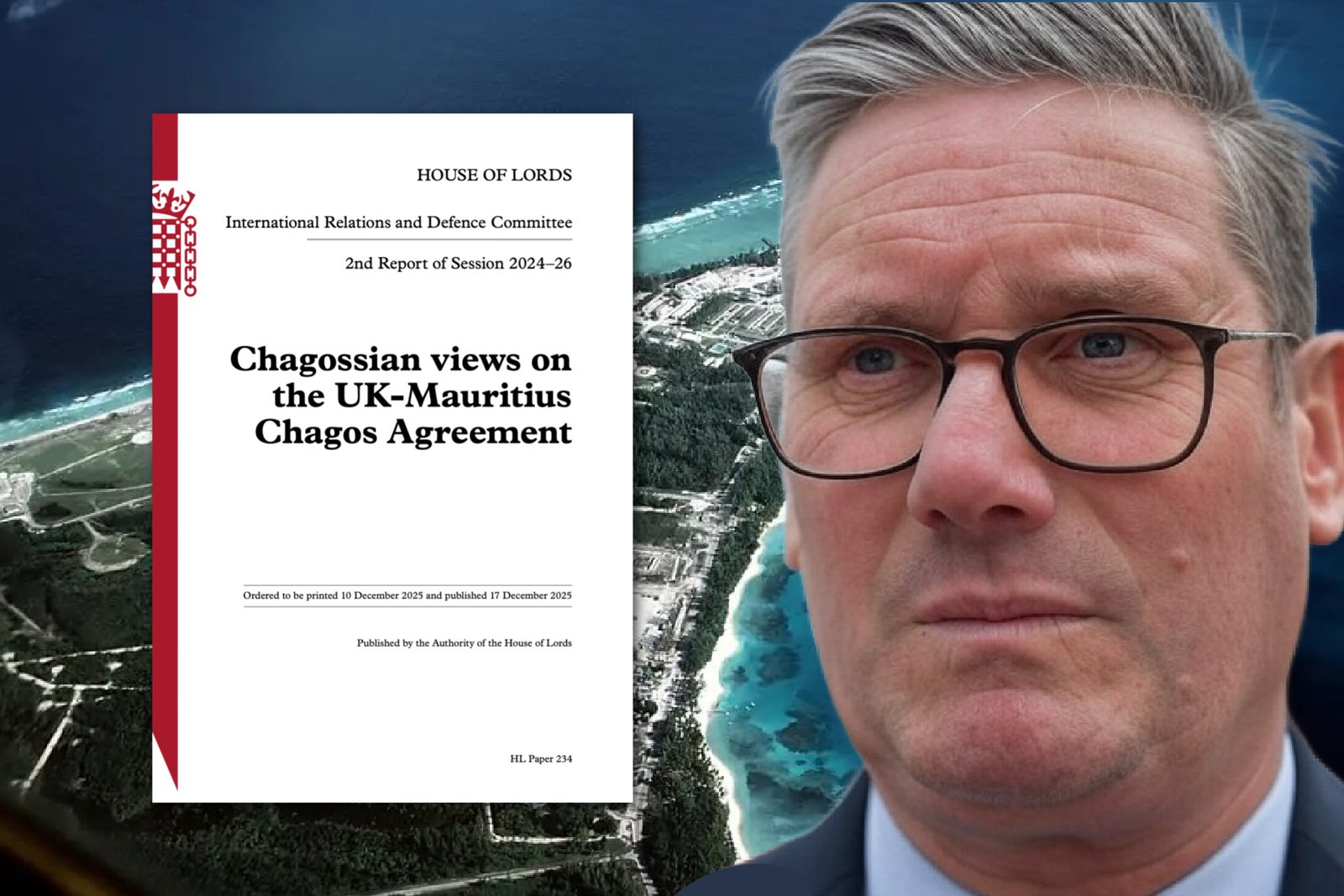
Ministers asked the Chagossian people what they thought of the plan to surrender their homeland to Mauritius. The answer they received amounts to one of the most damning indictments any government has ever handed itself.
Far from lending the agreement legitimacy, the results lay it bare as morally indefensible, politically reckless and rooted in the very same colonial contempt that drove a Labour government to expel the Chagossian people from their islands in the 1960s.
The consultation, run by the House of Lords International Relations and Defence Committee, drew responses from more than 3,000 Chagossians. It was commissioned only after ministers conceded that no consultation with Chagossians had taken place while the deal was being negotiated. The Committee freely admits the exercise arrived far too late and was no substitute for genuine engagement. Yet the responses are so consistent, so clear and so numerous that there can be no honest dispute about their meaning: this deal does not carry the consent of the people it affects, and it never has.
That, on its own, should have been enough to stop it.
Ignored, again
Between 1967 and 1973 the entire population of the Chagos Archipelago was forcibly cleared from their homes to make room for a joint United States and United Kingdom military base on Diego Garcia. Families were torn from their land, abandoned to poverty in Mauritius and the Seychelles, and condemned to live out their days in exile. Many died without ever setting eyes on their homeland again.
Half a century on, the same playbook has been used. Labour struck the sovereignty transfer behind closed doors, shut the Chagossians out completely, and only opened the door to parliamentary scrutiny once the ink on the agreement was already dry. The Committee states plainly that successive governments have, over decades, failed to engage properly with the Chagossian people, and that this latest process was no different.
This was no bureaucratic slip. It was a deliberate political choice to press ahead without consent.
The central finding: Chagossians do not want this
What stands out most sharply in the survey is the sheer depth and breadth of opposition to Mauritian sovereignty. Wherever the Chagossian diaspora is scattered across the globe, respondents voiced an overwhelming distrust of the Mauritian state and a profound fear that their interests would be brushed aside, or ignored altogether, once Mauritius took control.
The Committee records a widespread lack of faith in Mauritius to administer financial support fairly, to deliver any meaningful resettlement, or to safeguard Chagossian culture, land and rights. Time and again respondents raised the spectre of discrimination, corruption and marginalisation. Diego Garcia itself, the cultural and emotional heart of the community and the only island with serious infrastructure, is expressly shut out of resettlement under the agreement. The survey is clear that this exclusion is felt not as some technical footnote but as a profound personal and cultural wound.
If consent is the test, this agreement fails it entirely.
A racism too polite to name
An uncomfortable truth runs through the findings: Chagossians are being treated differently from other small island peoples whose wishes Britain professes to honour.
Respondents drew repeated comparisons with other British Overseas Territories, places where self-determination is protected, referendums are held, and local consent is treated as the final word. The Chagossians, by contrast, are told that international law renders their views inconvenient, their identity legally irrelevant, and their future something for others to barter. The Committee sets out these grievances without flinching, even where ministers would sooner avert their gaze.
This is not neutrality. It is a hierarchy of whose voices are allowed to count.
That the Chagossians are a predominantly Black, Creole community uprooted by colonial force is no accident of the story. The survey documents allegations of racism, marginalisation and neglect under Mauritian rule, the very concerns respondents say London's Labour Government is waving away in the name of diplomatic convenience.
A resettlement promise with no right to return
Defenders of the deal hold up resettlement as proof of progress. The survey shows precisely why the Chagossians see it as hollow.
The agreement guarantees no right of return whatsoever. It does no more than permit Mauritius, entirely at its own discretion, to set up a resettlement programme on islands other than Diego Garcia. There is no obligation, no timetable, and no secured funding for housing, healthcare, education or jobs. The Committee notes deep scepticism that any such programme would ever be delivered.
Respondents grasp exactly what that means. A promise that cannot be enforced is not a right. Many declared they would have nothing to do with any resettlement scheme run by Mauritius. Others said they would contemplate return only if Chagossians themselves held the reins over planning, governance and employment.
Not one of these conditions is reflected in Labour's agreement.
The UN question Labour wants to close, not answer
Ministers insist the deal lays Britain's international difficulties to rest. The survey points the other way. By sidelining the very people whose displacement drew international scrutiny in the first place, it cements the grievance rather than settling it.
Many respondents demanded Chagossian agency, representation, and in some cases a direct say over sovereignty itself. The majority make plain that, given the choice, they would rather the islands stayed a British Overseas Territory than pass to Mauritius. That preference may be awkward for ministers, but it is both politically and morally decisive.
You cannot claim to be decolonising a territory while silencing the colonised.
A deal that should not survive scrutiny
The Committee stops short of issuing formal recommendations, and it does not need to. Its conclusions speak for themselves, and the injustices the survey lays bare fall squarely at the door of the Labour Government.
Labour now confronts a stark choice. It can pause, listen, and rebuild a process anchored in Chagossian consent, or it can ram through a settlement that its own evidence shows the affected people reject outright. History will record which road it took, and the Chagossians, once more, will carry the cost.
All hope is not lost
For all the Government's determination to force the treaty over the line, the handover of the Chagos Islands is not yet done. The agreement remains unratified, and Parliament still holds a decisive hand.
The legislation returns to the House of Lords on 5 January, with a third reading to follow. Ministers are understood to want the whole matter wrapped up by 1 February 2026. Barring intervention from Parliament, that is the day British sovereignty would be snuffed out and the islands handed to Mauritius.
But the deal has already started to crack. Implementation slipped last month when the Government stared down the prospect of defeat in the Lords, forced to pause the legislation after an amendment was tabled demanding consultation with Chagossians before any further progress. That pause revealed just how brittle the agreement becomes the moment it meets real scrutiny.
The Chagossians have responded with an unprecedented step. Through an independently organised process facilitated by the Great British PAC, families forcibly evicted from the islands between 1967 and 1973 have declared the formation of a Chagossian government in exile, a direct bid to stop their homeland being signed away without their consent.
The community has elected a first minister and announced its intention to remain British citizens and loyal subjects of the King. Its purpose is unambiguous: to convince the House of Lords to block the Prime Minister's plans and to claim the same right of self-determination enjoyed by every other British Overseas Territory.
Delivering his inaugural speech, the newly elected first minister, Misley Mandarin, set out what the declaration stands for.
“Let the world know, we remain loyal subjects of His Majesty.
We remain committed partners to the United Kingdom and the United States. Tonight, the Chagossian voice becomes one voice. Tonight, our story begins anew.
We are still here. We are still Chagossian. And tonight, we rise. God Save the King.”
Britain has administered the Chagos Islands since 1814. In the 1960s the then prime minister, Harold Wilson, allowed the United States to build a major military base on Diego Garcia, and the original inhabitants were forcibly removed, many in time settling in the United Kingdom.
Prime Minister Keir Starmer signed the treaty in May, giving up British sovereignty and tying the UK to enormous payments to Mauritius, a country that has never once ruled the islands.
Mr Mandarin has stressed that the Chagossian cause is not merely about the past but about the future. The Chagossians want to go home to their islands, to remain British under British sovereignty, and to protect Diego Garcia and the wider Western security architecture that leans upon it.
The government in exile will now draw up a charter and set up a representative council. Work is under way to win recognition from an international leader, a step that, if it succeeds, could fundamentally reshape the political and diplomatic landscape around the treaty.
The message to Parliament could not be plainer. This is no closed chapter. The deal is not final. And the people whose homeland is being traded away will no longer hold their tongue.
Read the International Relations and Defence Committee's findings here: publications.parliament.uk
Main Image: The Chagos Islands are home to Diego Garcia, a UK / U.S. military base of significant strategic importance, particularly for operations in the Middle East, South Asia, and Africa. Scene Camera Operator: PH2 Frazier. Copyright: Public Domain.