
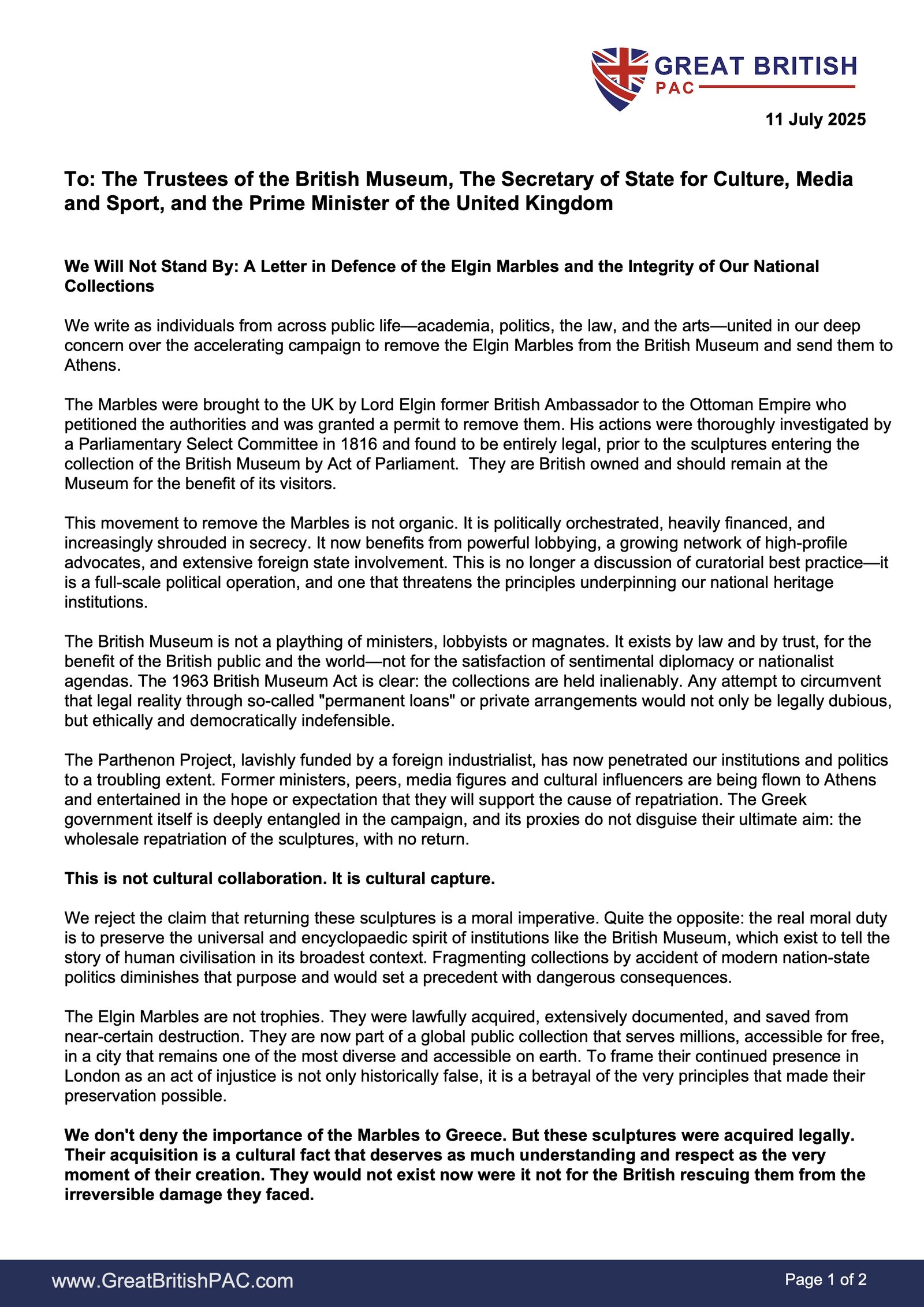
A broad alliance of British public life has drawn a line in the sand over the Parthenon Sculptures. Politicians from across the parties, alongside peers, lawyers, historians and cultural figures, have put their names to a public letter warning the British Museum that any quiet handover of the so-called Elgin Marbles to Greece will be fought every step of the way.
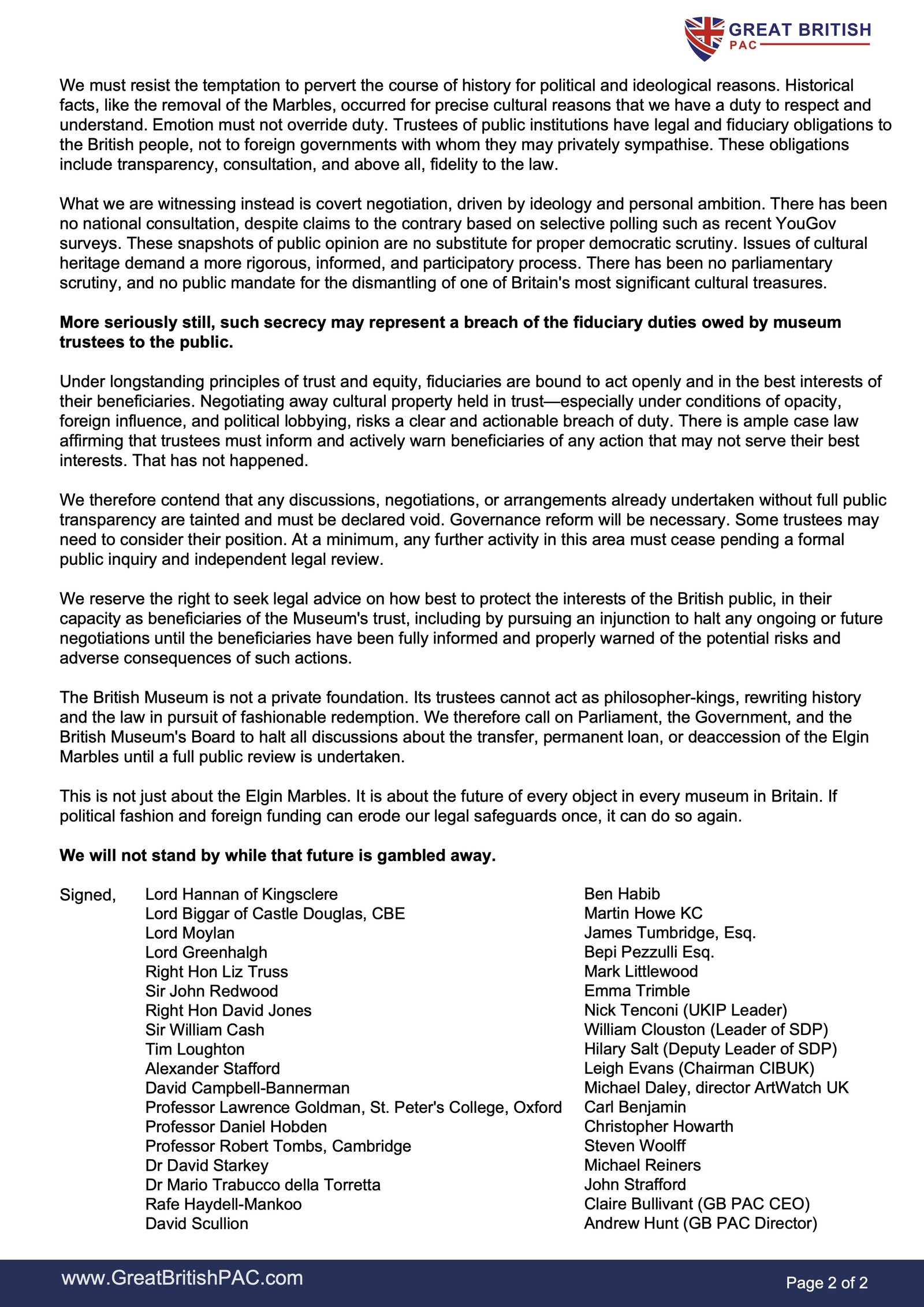
The letter — addressed jointly to the Museum’s Trustees, the Culture Secretary and the Prime Minister — calls for an immediate halt to what its authors describe as secretive plans to ship the sculptures to Athens. We at the Great British PAC organised it together with archaeologist Dr Mario Trabucco della Torretta, and it now carries the signatures of more than 30 prominent figures, among them former Prime Minister Liz Truss, the historian David Starkey and Lord Hannan.
Its message is blunt: “We will not stand by while the Elgin Marbles are given away.” The signatories defend the Marbles as a British cultural asset and caution that any “deals” to send them to Greece could breach the fiduciary and legal duties that museum trustees owe to the British public.
Behind the letter lies mounting unease about backdoor talks between the British Museum and the Greek government — talks given momentum by the lobbying of the foreign-funded Parthenon Project, which is chaired by Lord Vaizey. Those who signed argue that the negotiations are being driven by “secrecy, foreign influence, and political lobbying”, and that they risk doing irreversible harm to Britain’s public collections.
The letter does not mince words about the Museum’s obligations: “The British Museum is not a private foundation. Its trustees cannot act as philosopher-kings, rewriting history and the law in pursuit of fashionable redemption.”
What the letter warns against
Among the central concerns it sets out are:
- The absence of any public consultation or parliamentary scrutiny of the proposed transfer.
- Legal warnings that the move could breach the British Museum Act (1963), which prohibits disposing of objects from the collection.
- The troubling part played by foreign funding and state-backed lobbying in trying to shape UK museum policy.
- The danger of setting a precedent that could threaten cultural collections right across Britain.
A shared cultural inheritance
David Starkey, one of the letter’s leading backers, stressed how much the sculptures’ presence in Britain has shaped our culture:
“Before Lord Elgin brought them to London, knowledge of the sculptures’ appearance depended on a handful of engravings. Their arrival in Britain ignited a wave of neoclassical inspiration—from Buckingham Palace to the British Museum itself. To suggest they belong only to one country is to ignore the very cultural exchange that gave them meaning and preserved them.”
The letter also points to an uncomfortable irony for those who dismiss the Marbles as “loot”: far from being plundered, the sculptures were in fact rescued from destruction under Ottoman rule, while countless other classical artefacts were lost for good. As Starkey put it, “the Marbles survived because they came to Britain”.
Dr Mario Trabucco della Torretta, a leading campaigner for keeping the statues in the UK, made a similar case:
“We understand the Greek attachment to these sculptures, but this focuses solely on the moment of their creation, neglecting to tell a much richer cultural story. Their lawful acquisition is an early example of conservation, and it is in itself a cultural fact that had profound effects on British culture. This story deserves to be understood and respected just as much as their origin, and it is an essential part of our identity, both as Britons and as Westerners. No nation can claim a monopoly on that.”
The demands
The signatories are calling for three things:
- An immediate suspension of any ongoing negotiations or private agreements.
- A formal public inquiry and an independent legal review.
- A reaffirmation that the Museum must act in trust for the British public — not in the interests of foreign governments or private ideologies.
Our hope at the Great British PAC is that this cross-party letter forces the issue into the open and rallies the country around what many now see as a tipping point for Britain’s cultural sovereignty.
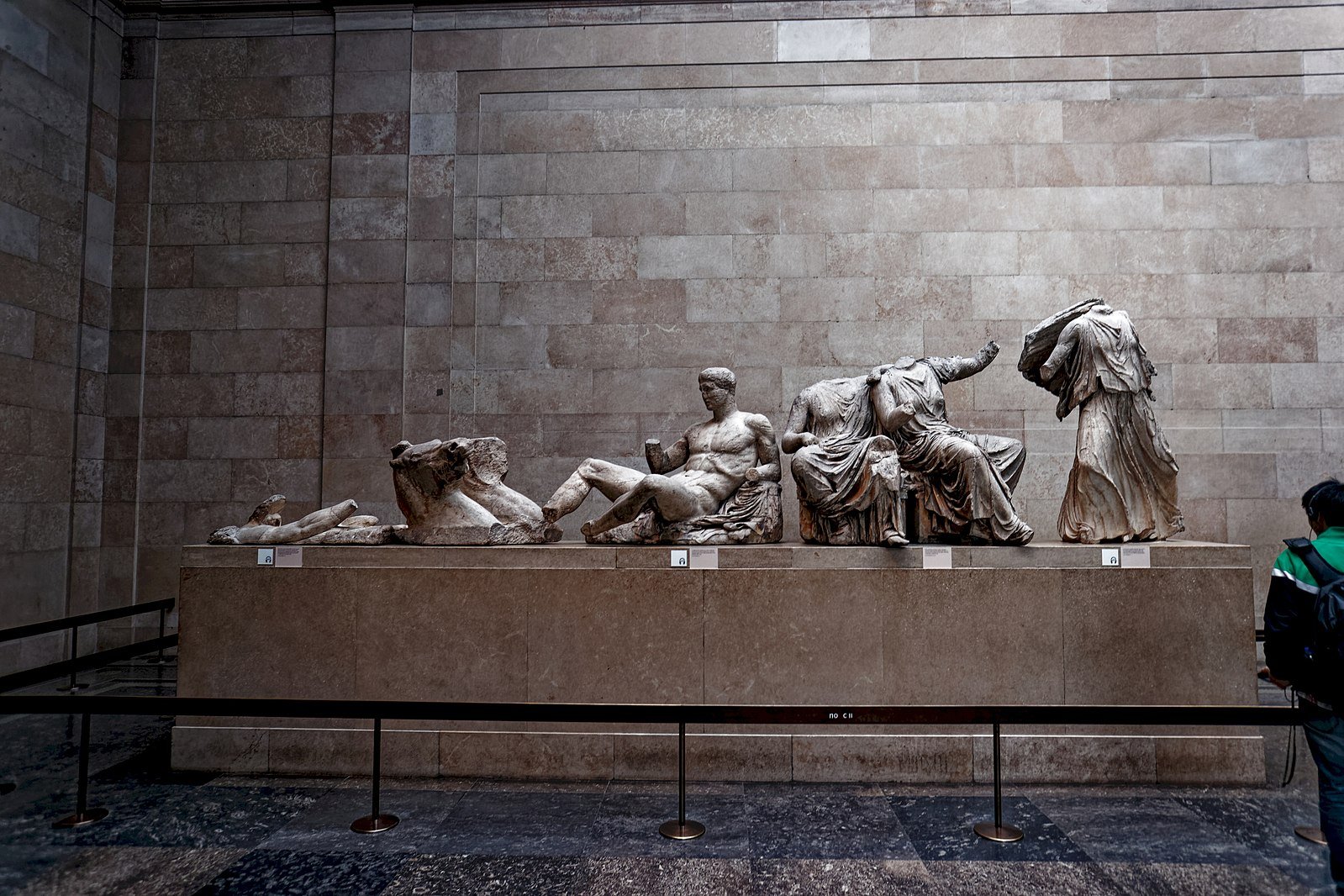
Main Image: Elgin Marbles CC BY-SA 4.0, via Wikimedia Commons. Licensed under the Creative Commons Attribution-Share Alike 2.0 Generic license.