
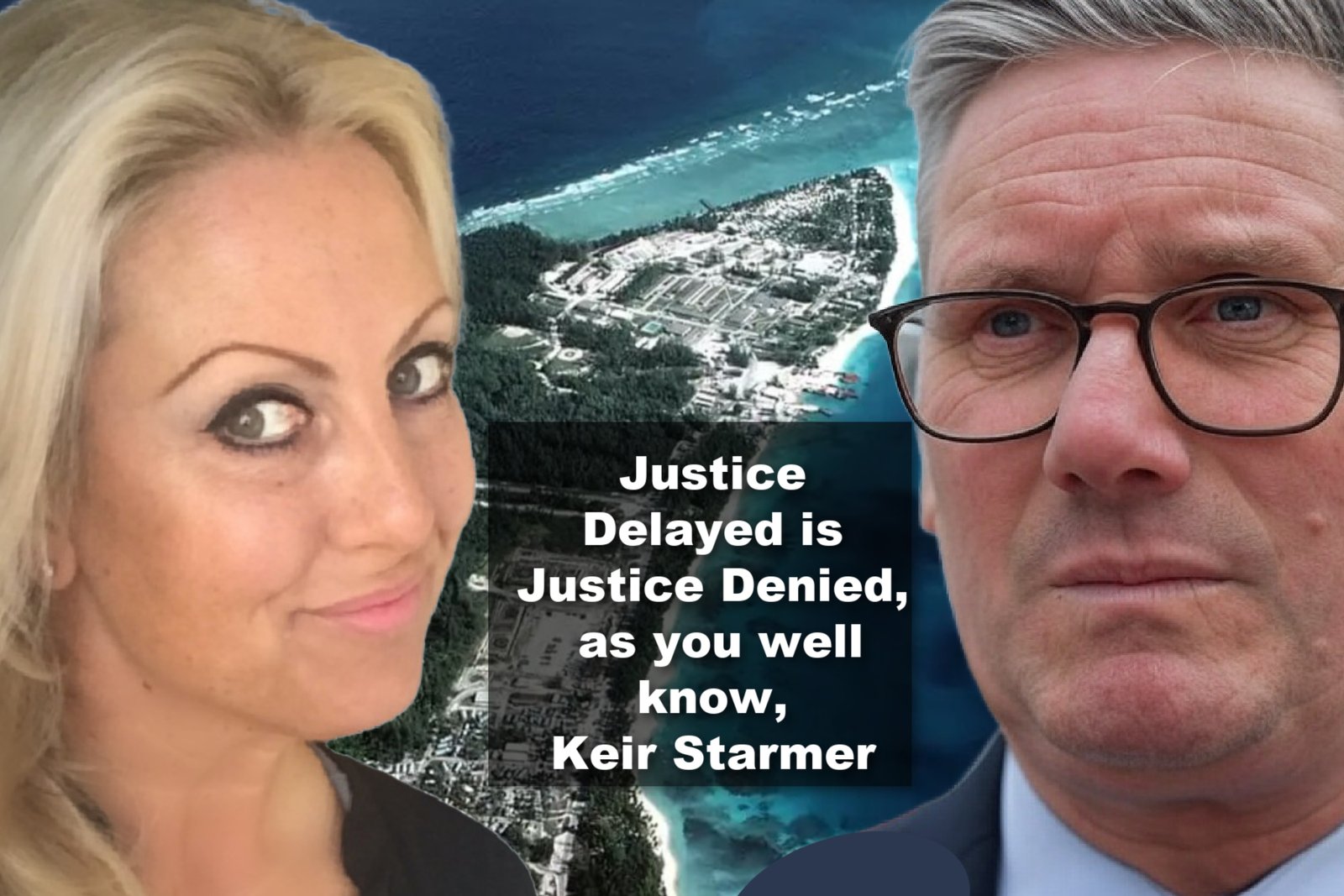
A fully funded, fully argued Judicial Review sits without a ruling. Meanwhile, the Labour Government quietly speeds an irreversible deal through Parliament across Christmas and the New Year. Deadlines move. Timetables compress. The gaps fill with silence. And with the clock running down, there is a real danger that justice arrives far too late to count for anything. Great British PAC CEO Claire Bullivant asks why this is happening, and who stands to gain when delay quietly achieves what an outright refusal never could.
It was roughly a year ago that I admitted to myself how little I genuinely understood about the Chagos Islands.
Like most people, I carried only a hazy sense that a military base sat somewhere out in the Indian Ocean. What I had not grasped was quite how essential it is. Then I looked at a globe, and once you have done that, the reality is impossible to look away from.
On that entire side of the planet, nothing else delivers for British and American military interests the way Diego Garcia does. It is where our nuclear submarines are serviced, where our warships dock, where our aircraft are staged. None of that is symbolic or theoretical. It ranks among the most strategically vital military installations anywhere on earth.
It is the single location on that side of the world from which the West can project power, deter its adversaries, and underpin global security.
You can therefore picture my disbelief on learning that Keir Starmer's government means to hand sovereignty of the Chagos Islands to Mauritius, a nation that has drawn closer to China in recent years, and then to rent back the very base we already command, at a cost that could eventually run past £35 billion for British taxpayers.
I simply could not make it make sense.
Why surrender sovereignty over territory of such strategic weight? Why pour out enormous sums to lease back something we already hold? Why would any responsible government do such a thing while the public finances are stretched to breaking point?
Getting no answers, I did exactly what citizens are meant to do in a democracy. I asked questions.
I wrote to Keir Starmer and David Lammy to demand transparency. The letter was unambiguous, and it carried the signatures of senior figures from right across politics, including Liz Truss, Nigel Farage, Sir Iain Duncan Smith, Suella Braverman, Baroness Hoey, Ben Habib and Sir Jacob Rees-Mogg. It warned of the risks to national security. It challenged the eye-watering cost to taxpayers. It drew attention to the total lack of consultation with the Chagossian people themselves. All it asked for was prudence, debate, and openness.
No meaningful response came back.
So I wrote a second time. Further names were added. Even more senior figures staked their reputations on the demand for scrutiny. Still nothing.
By that stage it was plain that something was badly wrong. Deals on this scale are not supposed to be conducted in silence. They are not supposed to be hurried. And they are most certainly not supposed to shut out the very people whose homeland is being decided on their behalf.
Then I met the Chagossians in person.
Nothing had prepared me for what they described.
They told me about the late 1960s and early 1970s, when an earlier Labour government forcibly removed them from their islands. Their animals were rounded up and killed. Their possessions were thrown into the sea. Families were loaded onto boats and left in Mauritius, the Seychelles, or Britain, with no support and no right to return.
I cried as I listened.
And yet what affected me most was this. After everything done to them, these people still want to remain British. Those living here have grown to love Britain. Many have served in the British Army. They take pride in their bond with this country. They are proud to be British. Britain, they told me, had treated them well. Mauritius had not.
That is the reason I resolved to fight for them.
Through the Great British PAC, we helped raise the funds for a Judicial Review. By early summer the money was secured, thanks to PAC donors and a substantial donation from Ben Habib. Our superb barrister, James Tumbridge, assembled an extraordinary and exhaustive submission, running to more than 1,600 pages, setting out the law, the history, and the case for why the Chagossians are entitled to the most fundamental democratic right of all, self determination.
Then came the delays.
This was supposed to be an expedited case. The first judge to grant permission said as much. Yet before long the progress slackened and then halted entirely. Questions went unanswered. Communication dried up. After that the court closed for the summer.
We waited.
Autumn arrived. We waited once more.
At last, at the end of October, we had our day in court before Mrs Justice Stacey. We were told a decision would come that same day.
It did not.
Then it was to be the following week. Then November. Then before Christmas.
Now we are told it will most likely be 12 January, once the court reopens after Christmas.
But by that point Parliament may already have passed the decisive stages of ratification. Strangely, Keir Starmer has fixed the Report Stage for 5 January and the Third and Final Reading for 7 January.
So I ask, plainly and clearly, what was the purpose of the Judicial Review if the process it was meant to protect is permitted to conclude before any decision is delivered?
Why did we labour so hard and pay for access to justice if justice is forever postponed? These questions demand answers.
Why is this Labour Government forcing this through over Christmas and New Year, fixing the Report Stage for the very first day peers return, while many are still away? Why were the amendment deadlines set for 23 December, when Parliament was running on fumes?
Why push ahead when the United Nations Committee on the Elimination of Racial Discrimination has expressly urged the United Kingdom to suspend ratification?
Why disregard the House of Lords International Relations and Defence Committee, which found that Chagossians wish to remain British and that a full and proper consultation is still needed?
None of this proves a conspiracy, of course. But it does demand an explanation.
Because when timing, haste, and silence all line up together, trust starts to erode.
The Great British PAC has since helped the Chagossians set up a Government in Exile, not out of anger, not out of rebellion, but because they are terrified of being erased from history through procedure and delay.
And I cannot shake the feeling that something fundamental has broken when a democratic state moves quicker than the law built to hold it to account.
Justice delayed is justice denied. And if we let this pass without outrage, without scrutiny, and without answers, then the question is no longer only about the Chagos Islands.
It is about what kind of country we are becoming.
And so I am left posing questions that no citizen should ever have to ask.
Why is this government so set on rushing a decision of this magnitude through Parliament while everyone is on the festive break, when scrutiny is at its weakest and attention lies elsewhere? Why does Keir Starmer, a former human rights lawyer, seem so untroubled that an indigenous people are being denied consultation, that a United Nations warning has been waved away, and that a Judicial Review is being overtaken by political haste?
And when the courts themselves go silent, where is a citizen supposed to turn?
If a judgment is put off again and again, despite the acknowledged urgency, despite the clear consequences, despite the risk that justice will come too late to matter, what explanation is owed? And owed to whom? There is no obvious route to accountability. No clear mechanism for complaint that does not itself risk being futile or inappropriate. One is left holding nothing but questions, and a mounting sense of unease.
This is not an accusation. It is something worse. It is the slow erosion of confidence in a system that is meant to shield the powerless from the powerful.
I helped organise a Judicial Review because I believed in the rule of law. I believed that when citizens raise money, gather evidence, and follow the process, the process would at the very least meet them halfway. I did not expect justice to be quietly outrun by a government timetable.
Yet here we are.
A Prime Minister driving a deal through Parliament at speed. A court decision forever deferred. An indigenous people forced so far to the margins that they have formed a government in exile merely to exist. And no one prepared to explain why all of this feels so wrong.
I feel sick that this is the state we are in.
Because when justice hinges on timing, and timing rests in the hands of those with the most to gain, then justice is no longer blind. It is merely late. And by the time it arrives, it may no longer matter at all.
That is not the Britain I believed I was fighting for. But I will not give up.
This matters, and it can still be stopped. Members of Parliament and peers now face a clear choice, to turn up, to scrutinise, and to vote with conscience when this deal reaches them on 7 January.
The Chagossian people must be given a say. Anything less would be a betrayal, not only of them, but of the very principles Britain claims to uphold.
By Claire Bullivant, CEO, Great British PAC.