Smear, silence, censorship: these have become the favoured instruments of the Left, and most organisations on the patriotic right have learned to flinch when they are deployed. We are not most organisations. Faced with exactly that kind of pressure this week, the Great British PAC stood firm — and the moment is making waves.
The episode began yesterday, when Hope not Hate — a self-appointed “anti-extremism” outfit — emailed us threatening to “expose” several of our directors and board members over posts they had supposedly liked or shared at some point in the past.
The dossier read like a tabloid hit list: posts from Tommy Robinson, opinions about vaccines, frustration over immigration. The horror. In short, the offence was that ordinary people had expressed views that fall outside Hope not Hate’s narrow worldview.
Their tactic was guilt by association. Their goal was intimidation. This time, it backfired.
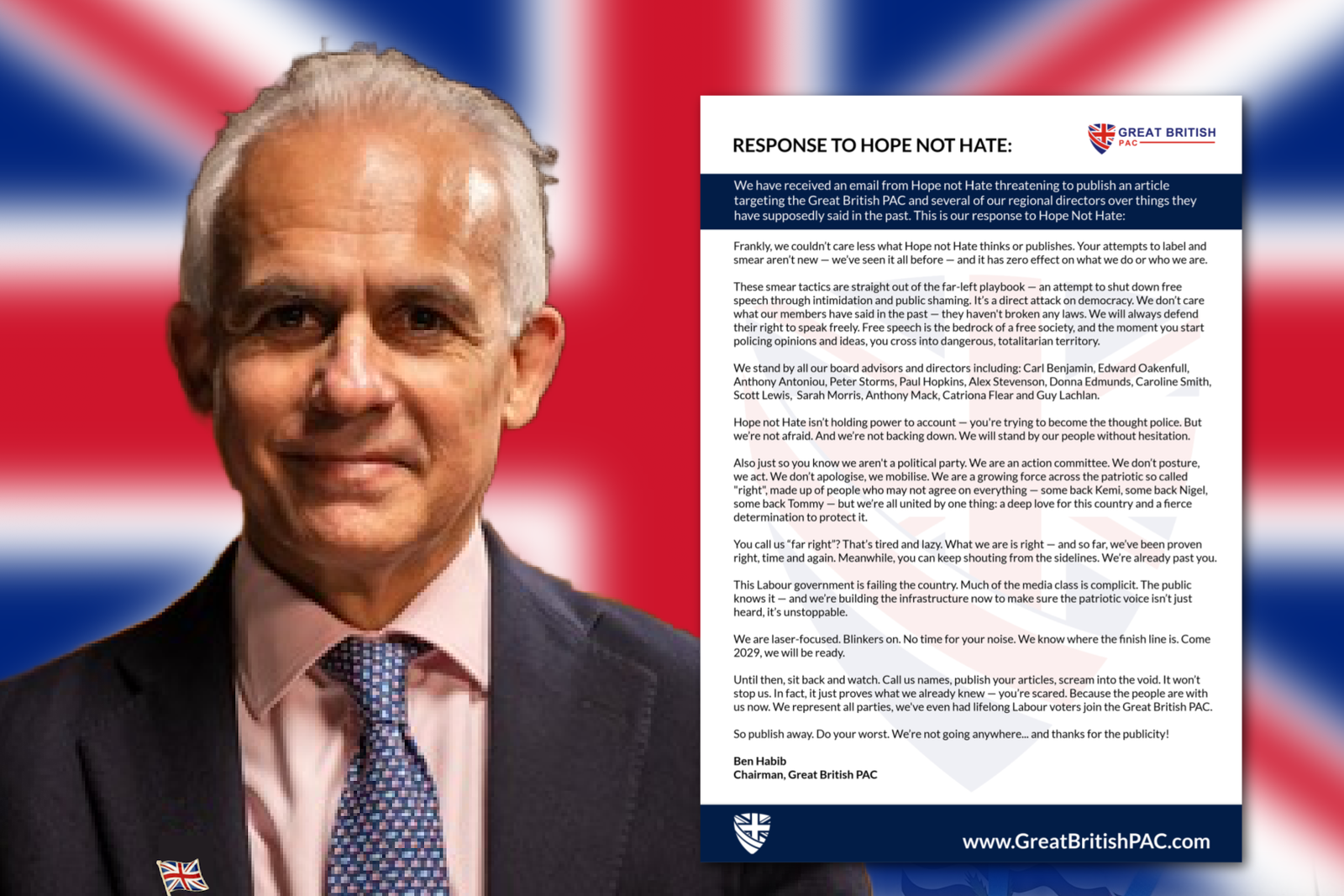
Instead of retreating or offering some mealy-mouthed apology, our Chairman Ben Habib answered with clarity, courage and conviction. His reply — now seen hundreds of thousands of times across social media — gave voice to a rising patriotic movement that is sick of being shouted down, labelled and ignored.
“Frankly, we couldn’t care less what Hope not Hate thinks or publishes. Your attempts to label and smear aren’t new — we’ve seen it all before — and it has zero effect on what we do or who we are.”
He went further, turning his fire on what he branded the “far-left playbook”: the strategy of closing down free speech through shaming and public pressure. “It’s a direct attack on democracy,” he declared. “We don’t care what our members have said in the past — they haven’t broken any laws. Free speech is the bedrock of a free society… and the moment you start policing opinions and ideas, you cross into dangerous, totalitarian territory.”
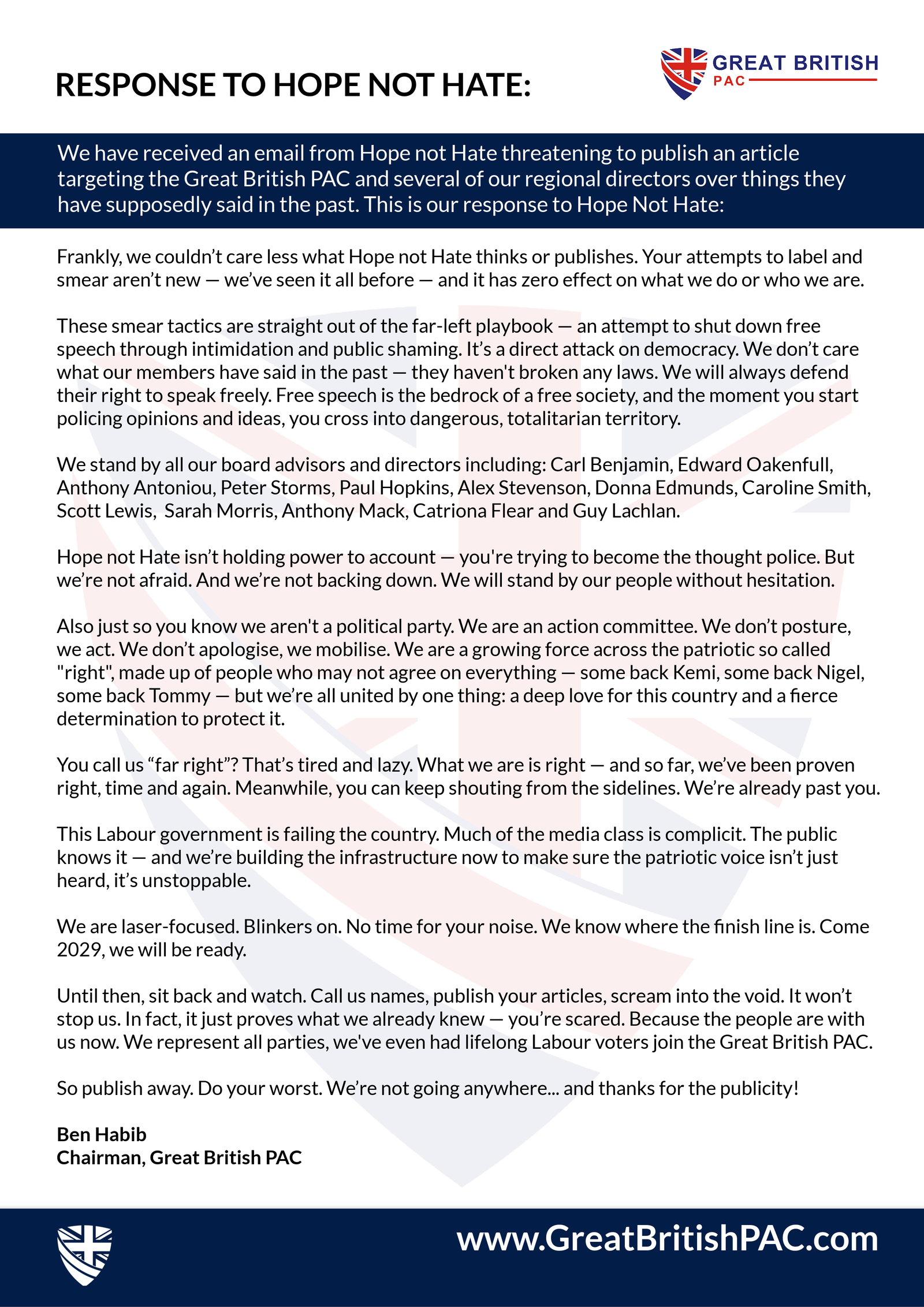
Hope not Hate may busy itself cataloguing a decade of tweets and likes, but our focus lies elsewhere: on the future of Britain. As Habib pointed out, the PAC is not a political party. It is an action committee — a growing, determined force that speaks for a broad cross-section of Britain’s patriotic right. “Some back Kemi, some back Nigel, some back Tommy,” he said. “But we’re all united by one thing: a deep love for this country and a fierce determination to protect it.”
What gives the game away is Hope not Hate’s fury that anyone would like a Tommy Robinson post or voice support for politicians beyond the approved elite. That is not extremism; it is freedom of opinion. But democracy is not what they are after. They want compliance — and they have appointed themselves the nation’s moral gatekeepers.
Make no mistake: this has nothing to do with holding power to account and everything to do with dictating what people may say and think. It is thought-policing by the book. And it is failing.
Habib left no doubt that the PAC will stand behind its people:
“You can try to bully our team — Carl Benjamin, Edward Oakenfull, Antony Antoniou, Peter Storms, Paul Hopkins, Alex Stevenson, Donna Edmunds, Caroline Smith, Scott Lewis, Sarah Morris, Anthony Mack, Catriona Flear, and Guy Lachlan — all you want. They really don’t care. They are patriots. Not pushovers.”
His parting words were blunter still:
“Come 2029, we will be ready. Until then, sit back and watch. Call us names, publish your articles, scream into the void. It won’t stop us. It just proves what we already knew — you’re scared. Because the people are with us now.”
The plain truth is that Hope not Hate’s methods are wearing thin. Britons have grown tired of the sanctimony, tired of the censorship, tired of being lectured on what to believe. Every attempt to mute patriotic voices only makes them louder.
Ben Habib and the Great British PAC are not apologising — they are building. And as the views, the follows and the grassroots support keep surging, one thing grows clearer by the day: the tide is turning, and no quantity of tweets, hit pieces or manufactured outrage is going to stop it.
Join the Great British PAC.